
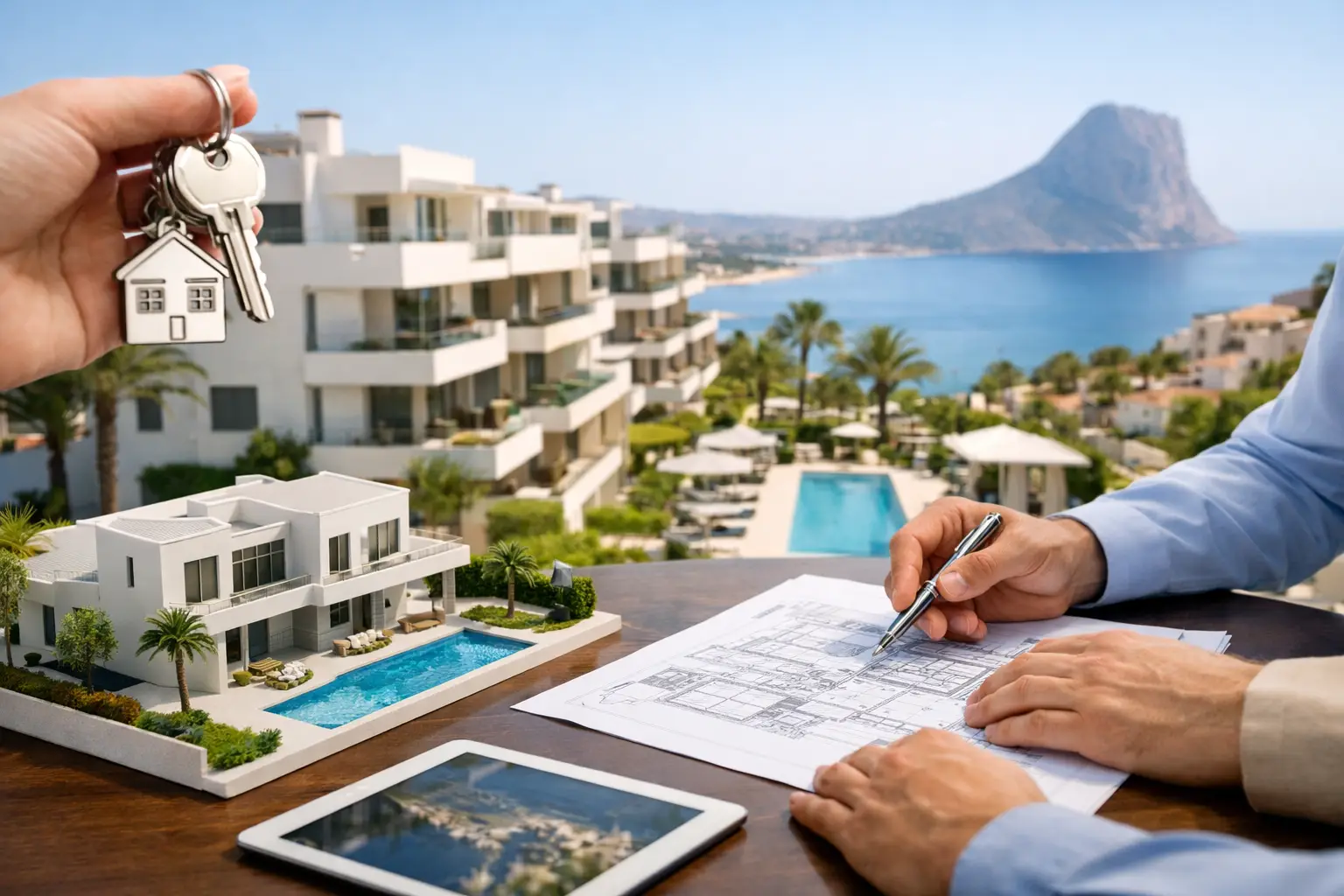
A striking sea view, a quieter address beside the fairways, or a lock-up-and-leave home close to a marina can all be found on the Costa del Sol. Yet the best opportunity is rarely simply the newest building or the lowest launch price. This guide to buying new developments is designed to help you assess the location, developer, legal position and future appeal behind the showroom image – so your purchase supports both the lifestyle you want and the value you expect.
Start with the location, not the brochure
New developments are being delivered across the Costa del Sol, from the established prestige of Marbella and Benahavís to the space, golf and coastal character of Sotogrande, Casares, Manilva and La Alcaidesa. Each offers a different rhythm of life, buyer profile and investment case.
A beachfront residence in Estepona may suit buyers who want walkable restaurants, a marina atmosphere and straightforward holiday rental appeal. A contemporary villa in Benahavís can offer privacy, elevation and proximity to Marbella, while Sotogrande has enduring appeal for those who value international schooling, golf, polo and a more discreet setting. The right choice depends on how you will use the property. A family home, a second residence and an investment-led purchase should not be assessed by exactly the same criteria.
Look beyond the plot itself. Consider journey times to Málaga and Gibraltar airports, beach access, views that are genuinely protected, nearby construction, golf or club membership options, local services and the quality of the surrounding streets. A development may feel secluded, but a future road, commercial site or neighbouring phase can alter that experience. Ask what is planned nearby, not only what exists today.
What makes a new development worth buying?
Off-plan and newly completed homes offer advantages that resale properties cannot always match: contemporary design, energy-efficient construction, modern insulation, secure communal areas and amenities such as a gym, spa, co-working lounge or concierge service. For overseas owners, the appeal of a low-maintenance home with a warranty and professional community management is considerable.
The trade-off is that you are buying into a scheme rather than judging a finished home in its final setting. Computer-generated images, show flats and material boards are useful, but they are not a substitute for reviewing the specification, plans and contract. Views may differ by floor, terraces can vary significantly between units, and the orientation that looks ideal on a site plan may feel very different at midday in August.
Price should be considered in context. A launch price can be attractive, particularly in a limited, well-positioned project, but a discount alone does not make a property a strong purchase. Compare the price per square metre with credible nearby alternatives, then account for outdoor space, parking, storage, build quality, facilities, running costs and the scarcity of the specific location. A smaller home with open sea views and excellent access can be more resilient than a larger property in an oversupplied area.
Assess the developer and delivery record
Established developers bring more than recognisable branding. Their track record can indicate how accurately they deliver specifications, how they manage post-completion issues and whether previous projects have held their appeal. This is particularly relevant where buyers are committing before completion.
Request clear information on the developer, architect, contractor and expected completion date. Visit completed schemes where possible. The quality of landscaping, communal maintenance, parking access and detailing in an earlier development often reveals more than a polished sales suite. It is also sensible to understand whether the advertised facilities form part of the first phase or depend on later phases being delivered.
A guide to buying new developments: the process
Once you have selected a property, the purchase process usually begins with a reservation agreement and a reservation payment. This temporarily removes the unit from the market while your independent Spanish lawyer reviews the paperwork and carries out the appropriate due diligence. Do not treat the reservation as a formality. Its terms, refund conditions and timeframe matter.
The private purchase contract follows, setting out the property, price, payment schedule, completion date, specifications and responsibilities of each party. Off-plan payments are commonly staged: an initial amount on signing, further payments during construction and the balance on completion before a notary. The exact structure varies by project.
For a new-build purchase, the buyer should receive protection for eligible stage payments through the required guarantees or insurance arrangements. Your lawyer should verify this carefully and confirm that every payment is made to the correct account, supported by the appropriate documentation. Never rely on verbal assurances where the contract or payment protection should provide the answer.
Before completion, a final inspection allows you to identify visible defects or incomplete works. A professional snagging inspection can be worthwhile, especially when you are abroad or purchasing a large villa. Minor issues are common in newly delivered homes; what matters is that they are recorded clearly and resolved through an organised handover process.
Budget for the full ownership picture
The asking price is only one part of the financial commitment. New-build homes in Spain are generally subject to VAT and stamp duty rather than the transfer tax usually associated with resale properties. Legal fees, notary and Land Registry costs, mortgage expenses where applicable, furnishing and insurance should all sit within your acquisition budget.
After completion, assess annual costs with the same care. Community fees can be higher in projects with extensive landscaping, 24-hour security, pools, wellness facilities and concierge services. For many buyers, those services are precisely what make ownership effortless. For others, particularly investors focused on net yield, a simpler community may be a better fit.
Ask for an estimated community budget, details of what it covers and any anticipated phased handover arrangements. If a development is still being completed around you, clarify when all facilities will be operational and how the community will be managed while occupancy builds.
Check the details that affect daily life
Luxury is often experienced in the practical details. Storage, parking dimensions, lift access, sun exposure, sound insulation and the route from garage to front door make a real difference to a property’s enjoyment and future saleability.
Review the plans closely. Confirm the built area, terraces, garden or solarium space, the precise location of parking and storage rooms, and whether furniture shown in marketing material is included. If a sea, golf or mountain view is central to your decision, visit the site at different times where possible and check the orientation with your adviser.
For homes intended for rental use, establish the development’s rules and the local requirements before assuming income. Some communities restrict tourist lets, while certain buyers may prefer a private residential environment with no short-term holiday turnover. Neither approach is inherently better; it should match your intended use and expected return.
Keep your advisers independent
An experienced local property adviser can narrow a large market to developments that genuinely suit your brief, including projects that may not be widely visible. They should also be candid about compromises. The closest home to the beach may have less privacy; the most dramatic hillside views may mean a longer drive; an early off-plan purchase may offer choice, but it also requires patience.
Alongside your agent, appoint an independent Spanish lawyer who represents your interests alone. Their role includes reviewing the contract, licences and guarantees, checking ownership and planning documentation, and supporting completion. Depending on the property and your circumstances, you may also wish to involve a tax adviser, mortgage broker and surveyor or snagging specialist.
A well-chosen new development can offer an exceptional way to own the Costa del Sol: contemporary architecture, considered amenities and a home shaped around Mediterranean living. Give the same attention to the paperwork, neighbourhood and long-term running costs as you do to the view. That is how a promising launch becomes a property you will be pleased to arrive at, year after year.
Ready to explore new developments on the Costa del Sol?
Choosing the right development is about far more than the launch price or the render on the wall. At The Property Agent, I help buyers look past the show flat — at the developer’s track record, the true cost of ownership, and whether a location will still feel right once the scaffolding comes down.
If you’re considering a new-build purchase in Sotogrande, Estepona, Benahavís, Casares, Manilva or La Alcaidesa, let’s talk through what matters most for your plans, so you can buy with the same confidence you’ll feel arriving at the finished home.