
Marbella Property Market Insights & Area Guide
Everything you need to know about Marbella before you buy: which areas suit which buyers, how the market works, what the planning situation means for you, and what living here is actually like outside July and August. If you already know the area, you can go straight to property for sale in Marbella.
Quick links
Introduction to Marbella
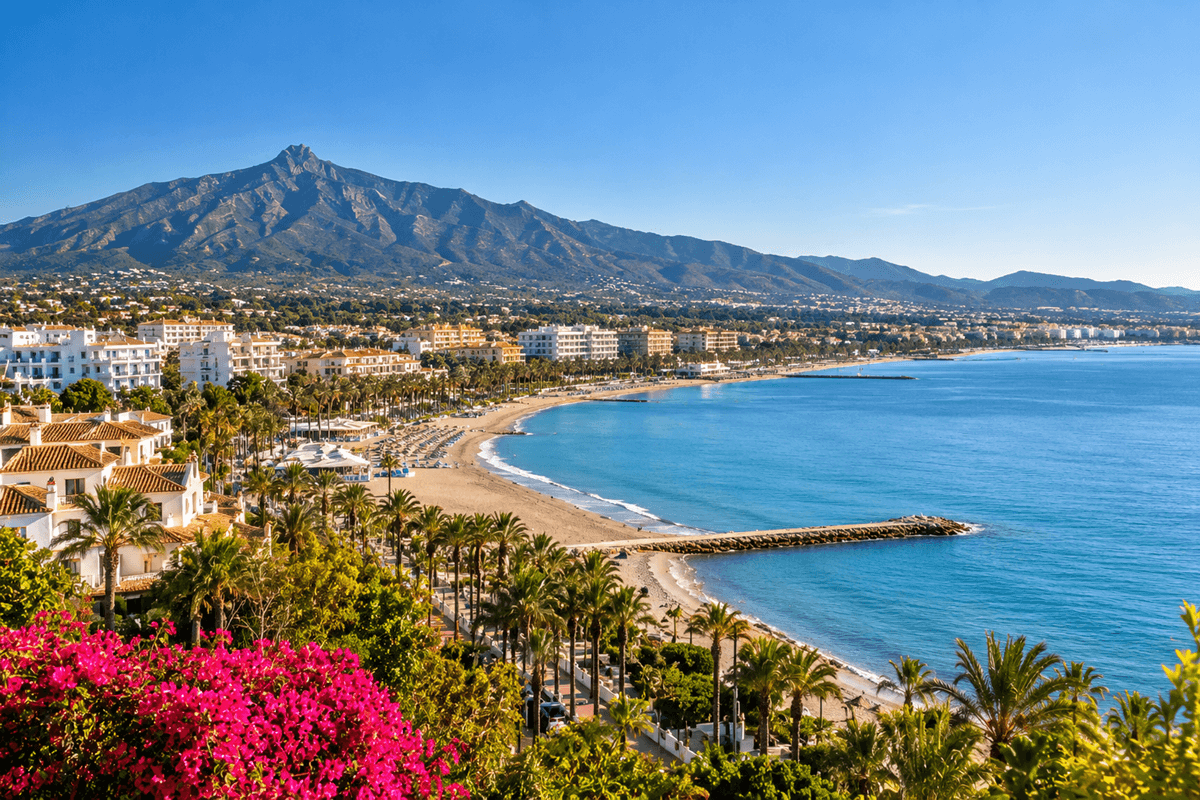
Marbella is a municipality of around 173,000 registered residents (municipal register, 1 January 2026), stretched along roughly 27 kilometres of coast between Mijas to the east and Estepona to the west, with the Sierra Blanca behind it. About 36% of those residents are foreign nationals, and the register added almost 7,000 people in a single year. The real population is higher still, particularly in summer.
It is large enough to work as a city all year round, with a public hospital, private hospitals, a long list of international schools and a commercial centre that doesn’t depend on the season. It is also the benchmark the rest of the coast gets measured against, and we compare it with other options in our guide to the best places for second homes on the Costa del Sol. When someone says an area is “the new Marbella”, they are admitting that Marbella is the reference point.
The location is a large part of the appeal. Málaga airport is around 50 to 60 kilometres away depending on which part of Marbella you are in, roughly 45 to 50 minutes by the AP-7 in normal traffic. Gibraltar is around 80 to 90 kilometres to the west, a little over an hour plus the border, which can take five minutes or much longer. Estepona and Benahavís sit just beyond the western edge of the municipality.
For buyers, the most important thing to understand upfront is that Marbella is not one market. The Old Town, the Golden Mile, the golf valley of Nueva Andalucía, Puerto Banús, San Pedro de Alcántara and the eastern strip from Río Real to Cabopino are separate propositions with different buyers, different property types and very different price levels. Choosing the right one saves a great deal of time later.
Marbella Old Town and the seafront
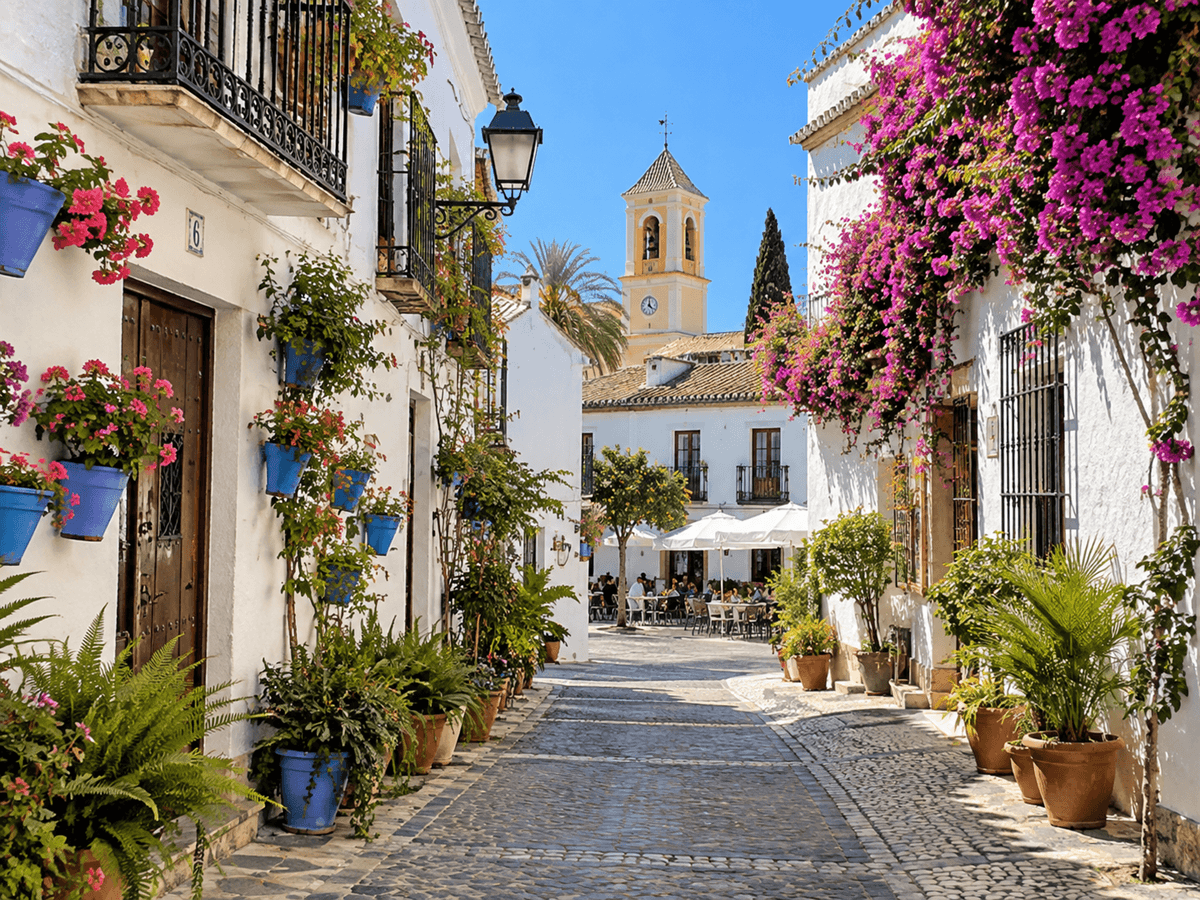
The Old Town is where Marbella still behaves like a Spanish town. The Plaza de los Naranjos, laid out in 1485 after the Christian conquest, is the centre of it, surrounded by the town hall, the Ermita de Santiago (the oldest Christian church in Marbella) and a web of whitewashed streets that follow the old Moorish layout. Nearby you will find the Museo del Grabado Español Contemporáneo, housed in the former Hospital Bazán, and the Bonsai Museum in the Arroyo de la Represa park.
Between the Old Town and the sea runs the Alameda park and the Avenida del Mar, an open-air sculpture promenade that includes works by Salvador Dalí. From there you reach the beaches of El Cable, El Faro and La Fontanilla, all of which carry a Blue Flag in 2026 and sit right next to the centre with full services.
The practical consequence for buyers is that you can live here without depending on a car for daily life, which is rarer than people expect on this coast.
Buying in and around Marbella Old Town
New build inside the historic centre barely exists. What comes to market there is almost all resale: small apartments, townhouses and the occasional house with a patio, and the good ones tend to move quickly. Like most historic centres, it has narrow streets and limited parking, so check access and garage options before you fall for a property.
That is not a reason to rule out the area, it is a reason to widen the search slightly. The streets just outside the historic core, towards the Alameda and the seafront, mix older buildings with newer apartment blocks and keep you within a short walk of everything. If you want something new without giving up the location, this is where it is worth looking.

Weather, beaches and landscape
Marbella has a subtropical Mediterranean climate: mild winters, hot and dry summers and an annual average temperature of roughly 18 to 19 degrees. The Sierra Blanca shelters the town from the north, which is a large part of why winter days on the terrace are normal here.
The beaches
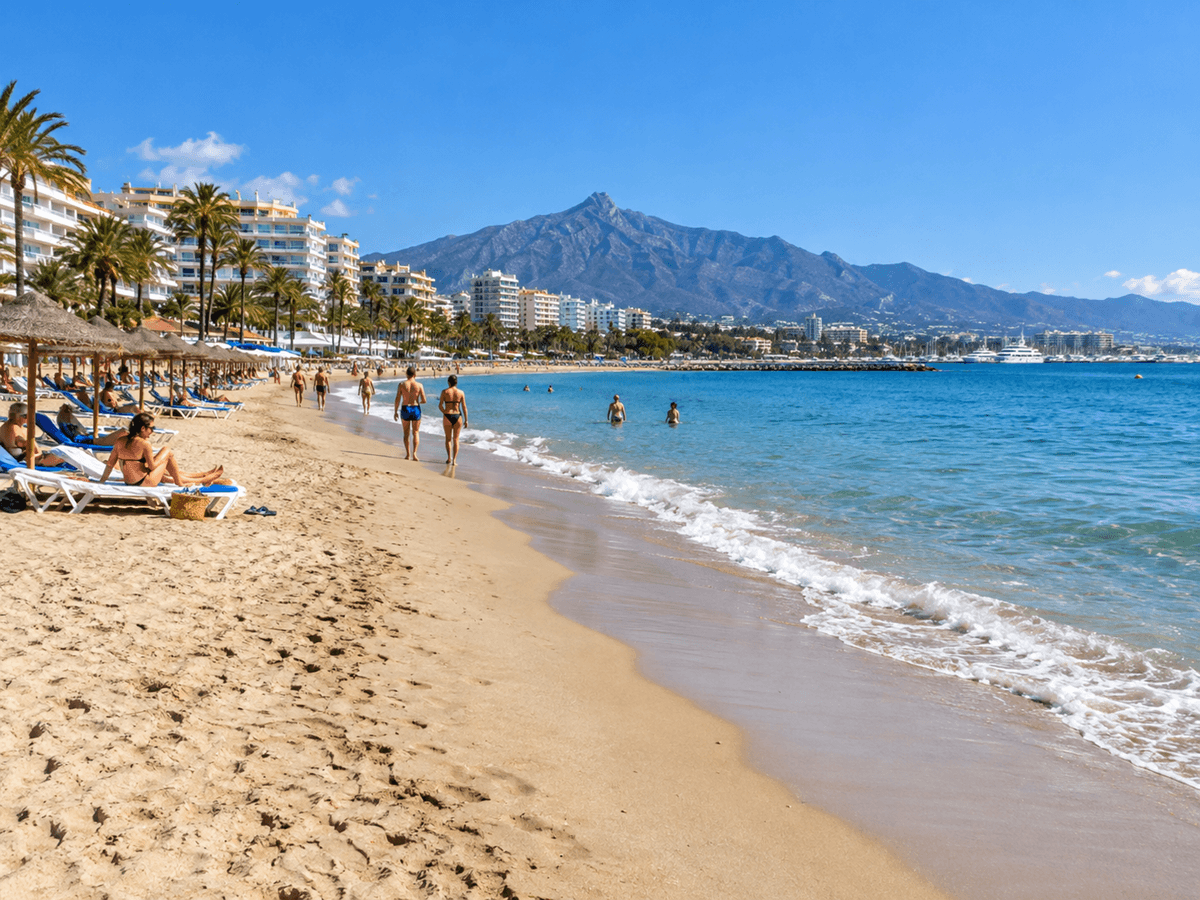
Marbella has around 25 beaches along its coastline, and in 2026 several of them hold a Blue Flag, including El Cable, El Faro and La Fontanilla. Blue Flags are awarded annually and can change from one year to the next, so treat this as a snapshot and check the current list.
They are quite different from one another, which matters before you pick a neighbourhood.
El Cable, El Faro and La Fontanilla are the town beaches: next to the Old Town, with chiringuitos, showers and everything within walking distance.
Nagüeles-Casablanca sits on the Golden Mile and has a small pier belonging to the Marbella Club hotel. This is the part of the coast people mean when they talk about beachfront Marbella.
Los Monteros (Adelfas) and the neighbouring Alicate are on the eastern side, a short drive east of the centre, and are favoured by people who want an established residential beach without the town crowds.
Cabopino, at the eastern edge of the municipality, combines a beach, a small marina and a stretch of natural dunes. It is calmer and less showy than the western half.
Guadalmina and San Pedro de Alcántara, to the west, are wide, easy beaches with a residential, family feel.
If walking to the sand is your priority, it is worth reading about what frontline beach property actually involves before you start viewing.
Sierra Blanca
Behind the town the ground rises quickly into the Sierra Blanca, whose summit, La Concha, stands at around 1,200 metres and is visible from most of the municipality. It offers hiking and mountain biking above the town, and for buyers it matters for two reasons beyond the walking. It limits how far development can climb, and the properties in the foothills, in Sierra Blanca and Nagüeles, trade distance from the sea for views, plot size and privacy.
Marbella property market insights
Marbella is a mature, international, high-value market, and it behaves like one. According to figures from the notaries’ association summarised at the start of 2026, prices in Marbella were still rising through 2025, at a slower pace than the year before, and more than 60% of purchases were made by foreign buyers. The town sits at the top end of the Spanish market, and prices have kept rising despite repeated predictions of a correction. These are 2025 figures and they will date, so treat them as context, not as a forecast.
What that average hides is the real story: the spread inside the municipality is enormous. A small apartment in a San Pedro urbanisation and a frontline villa on the Golden Mile share a municipality and almost nothing else. Location matters more here than finishes or square metres, and it is the one thing you have to see in person.
New build, resale and why it matters in Marbella
In our experience, Marbella is more resale-driven than its neighbours to the west. A large part of the housing stock was built between the 1970s and the 2000s, and a good deal of what changes hands is older property, which is why renovation is such a common variable here. New build exists, but it is concentrated in specific pockets: parts of Nueva Andalucía, the northern Golden Mile and the hills, San Pedro, and the eastern side around Las Chapas and Elviria. If you want modern specifications, energy efficiency and no renovation, in our experience the choice is narrower than in Estepona, which is exactly why it pays to work with someone who knows where the new projects are. There is more on the trade-offs in our piece on buying new versus resale.
The new urban plan
This is the part most guides skip and it is genuinely important. For decades Marbella operated under a 1986 general plan, and the 2010 attempt to replace it was annulled by the Supreme Court. The legacy is a substantial amount of housing built under licences that were later questioned, which is why checking the urban status of a resale property is not a formality here.
That is now changing. In September 2026 the town hall approved its new municipal plan (PGOM), adapted to the region’s new land-use law. It widens the amount of urban land, reserves 20% of the buildable area in urban land actions for affordable housing, and leaves the detailed ordering of each area to a second document, the POU, which is still being processed. In practical terms, expect clearer rules over the next few years, but not overnight. Anyone buying a plot or a property with development potential should treat the timetable as uncertain.
Holiday letting
Unlike the city of Málaga, which froze new tourist licences for three years from July 2026, Marbella had not introduced a blanket freeze at the time of writing. That does not mean it is simple. Whether you can let a property to tourists depends on the licence, on the planning rules for the plot and, above all, on the statutes of the community. Check them before you buy, not after.
What to weigh up honestly
Marbella is not the right answer for everyone, and it is better to say so. Prices are among the highest in Spain. Traffic on the coast road and the AP-7 in July and August is heavy, and moving around the western end at peak times takes planning. Some areas, Puerto Banús above all, are loud in summer. Many properties are resale with legal and technical checks that need doing properly. And the municipality is so varied that a good experience in one area tells you very little about another.
Luxury Apartments for Sale in Marbella

Armonia San Pedro – Marbella
Armonia San Pedro Apartments offer modern 2 & 3-bedroom homes…
Off Plan
485.850€

Residencial Albatros – Nueva Andalucia
Residencial Albatros Nueva Andalucía offers modern 2, 3 & 4-bedroom…
Off Plan
375.000€
Golf in Marbella
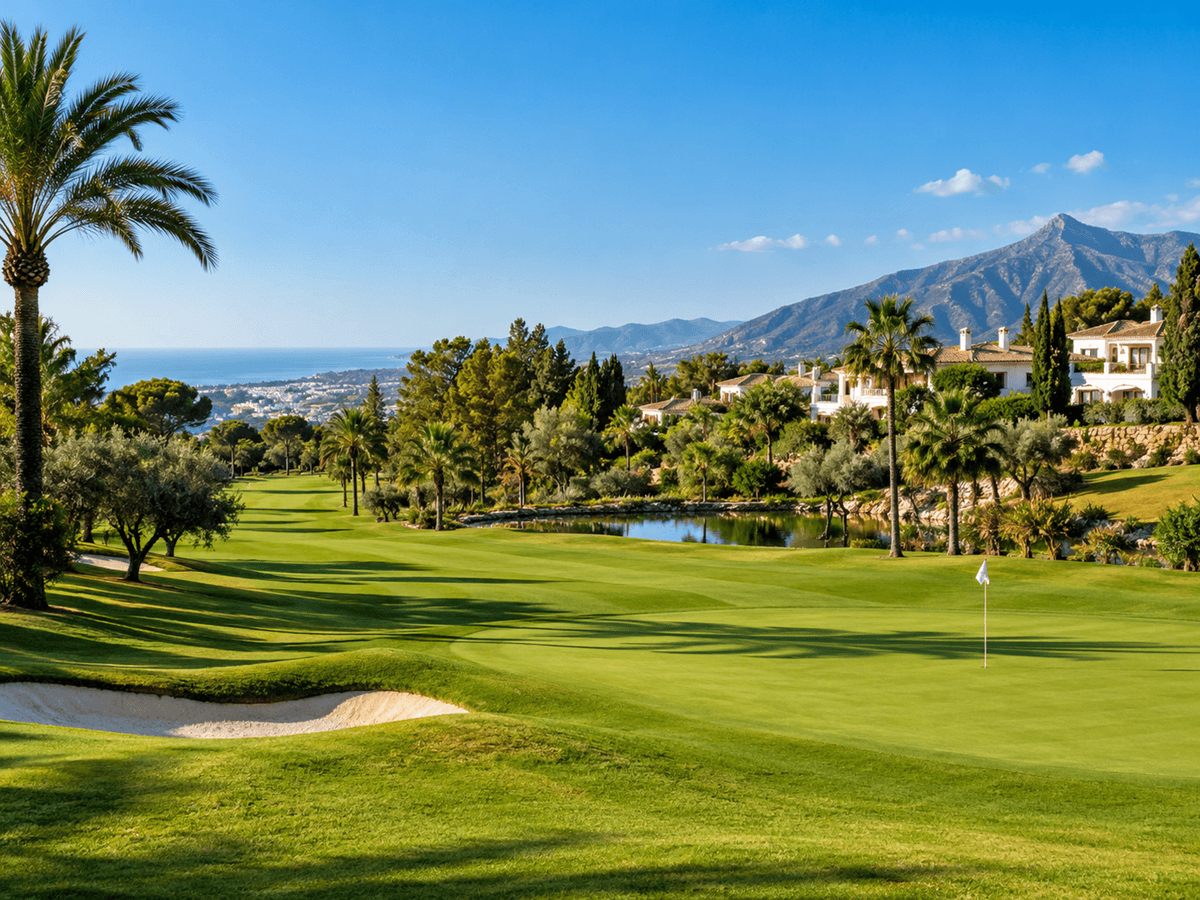
Rio Real Golf Course Marbella
Marbella is one of the best-known golf destinations on the Costa del Sol, with 14 golf courses in the municipality according to the town hall, and the greatest concentration sits in Nueva Andalucía, known as the Golf Valley. Real Club de Golf Las Brisas, opened in 1968 and designed by Robert Trent Jones Sr., has hosted the World Cup of Golf and the Spanish Open. Next to it, Aloha Golf Club is a work of Javier Arana and has hosted the Andalucía Open. Los Naranjos, another Trent Jones design from 1977, is more accessible, and La Quinta offers 27 holes.
Outside the valley, Real Club de Golf Guadalmina in San Pedro de Alcántara has two 18-hole courses, the older of which dates from 1959. On the eastern side you will find Río Real, founded in 1965 and also an Arana design, Santa Clara, Cabopino and the former Marbella Golf & Country Club, which became Higuerón Marbella Golf Resort in November 2025. Magna Marbella is a nine-hole course, and Banús Executive is a short, illuminated par-three layout. The famous Real Club Valderrama, home of the 1997 Ryder Cup, is in Sotogrande, not in Marbella.
For buyers, the useful distinction is between living on a golf course and living near one. Frontline golf properties carry a premium and, in some clubs, membership rules and fees. If golf is driving your search, it is worth reading about what living by a golf course is actually like and about buying an apartment near a golf course.
Puerto Banús, marinas and things to do
Puerto Banús opened in 1970, the vision of developer José Banús and the architect Noldi Schreck. It was built to look like an Andalusian fishing village, which it never was. Today it has 915 berths for boats of up to 50 metres, more than 100 boutiques and a reputation as one of the most exclusive marinas on the Costa del Sol. There are other marinas in the municipality, including Marbella’s own, La Bajadilla, and Cabopino, which are quieter and more local in character.
Puerto Banús is also where much of Marbella’s nightlife is concentrated, together with the Golden Mile. That is part of its appeal, and also something to weigh up if you are thinking of buying nearby and want quiet in summer.
Beyond the marinas, there is more to do here than the beach, which matters if you plan to be here in November as much as in July.
- The Old Town on foot. The Plaza de los Naranjos, the Alcazaba ruins, the Encarnación church and the Capilla de San Juan de Dios.
- Museums. The Museo del Grabado Español Contemporáneo has a large collection of contemporary Spanish engraving, and the Bonsai Museum is a surprisingly good half-hour.
- The Sierra Blanca. Hiking and mountain biking trails start practically from the urbanisations on the northern edge of the Golden Mile.
- Golf, tennis and padel. There is a wide choice of clubs.
- Beach clubs and resort hotels. The Marbella Club, from 1954, and Puente Romano, from 1979, anchor the Golden Mile.
Food and dining
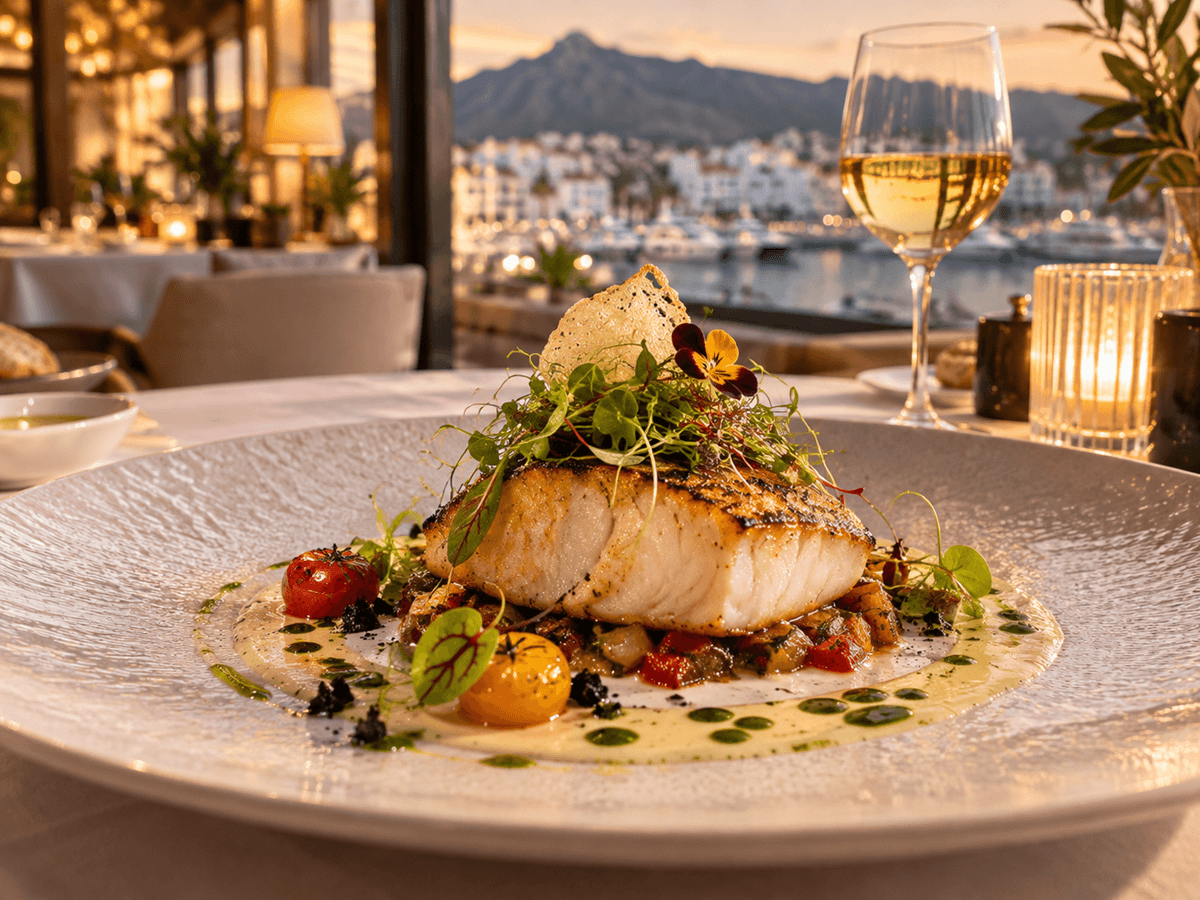
Delicious meal in Puerto Banus
Marbella eats well at every level, and the range is the point. In the Old Town you will find proper tapas bars with locals at the counter, around the Plaza de los Naranjos and the streets behind it. Along the beach, the chiringuitos serve espetos (sardines grilled on a cane over an open fire), fried fish and grilled seafood, at their best in the late afternoon. Puerto Banús and the Golden Mile are international: high-end restaurants, chef-led kitchens, hotel dining and a very active summer scene. San Pedro de Alcántara has its own, quieter, more residential eating scene.
The useful thing to know if you are thinking about living here is that, in our experience, the restaurant scene keeps going in winter. Not everything stays open, but the town and the Golden Mile keep going all year.
Fiestas and local events
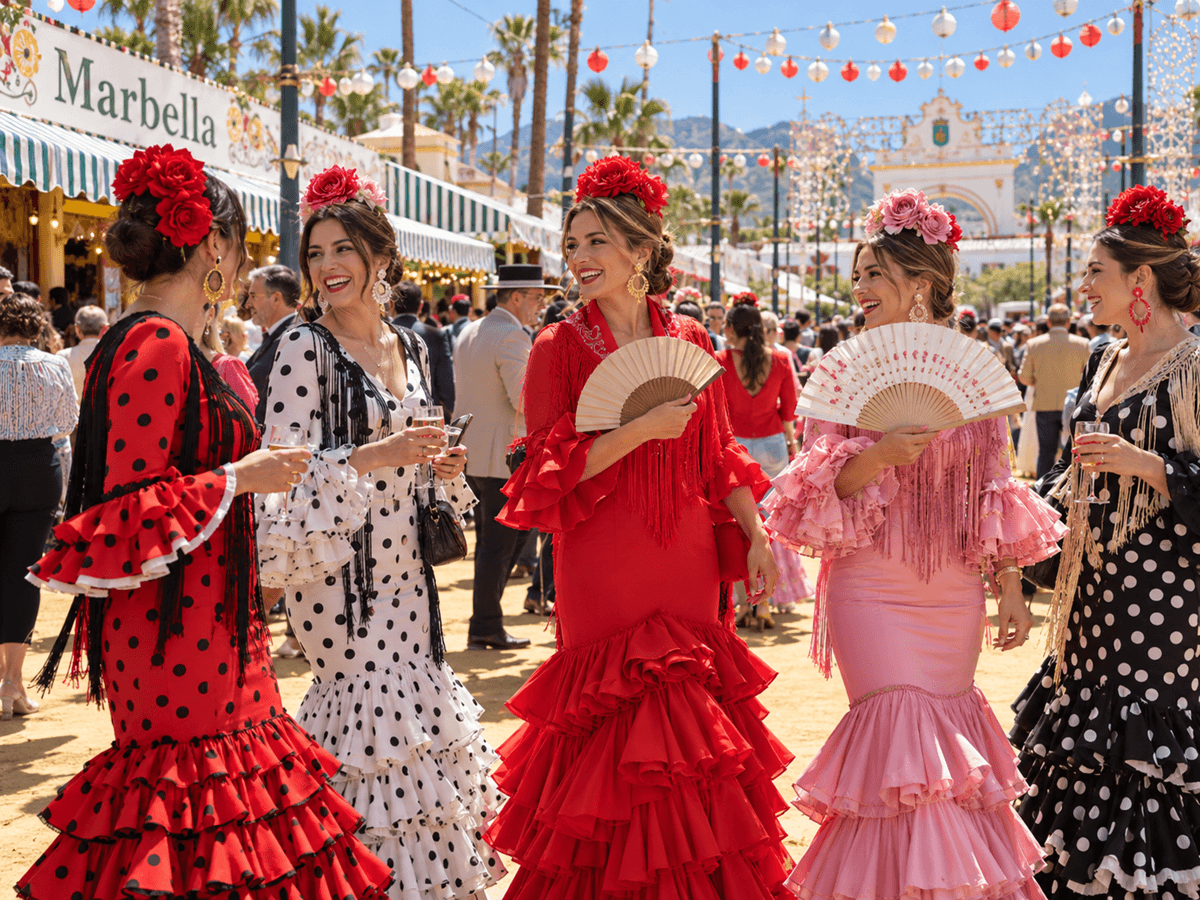
Feria de Marbella
Marbella keeps a real calendar, and it differs by district, which is one of the quieter signs that the municipality is made up of distinct places.
Semana Santa is the main religious event of the year. Processions run through the Old Town, San Pedro de Alcántara and Nueva Andalucía during Holy Week, and the San Pedro processions are well known locally.
San Bernabé is the patron saint’s fair, held in the week around 11 June, the anniversary of the town’s capture in 1485. It opens the Sunday before with the Romería de San Bernabé to the hermitage in the Nagüeles pine woods. There is a daytime fair in the Old Town and a night fair at the fairground.
La Noche de San Juan on 24 June is celebrated on the beaches with bonfires.
Virgen del Carmen, on 16 July, is the fishermen’s festival: the image is carried from land to the sea, with crowds along the seafront.
There are also smaller local fairs, including the feria in San Pedro de Alcántara and the one in La Campana, in Nueva Andalucía, which are worth visiting if you are considering those areas.
Marbella’s historical heritage
Marbella’s history is older than its image suggests. There are traces of Phoenician settlement along this coast, and there was a Roman settlement in what is now the Old Town: stretches of the old wall, with Roman ashlars and Ionic capitals built into them, still stand. The Moors fortified the town, and the Alcazaba ruins remain. The Catholic Monarchs took Marbella on 11 June 1485, which is why San Bernabé, whose feast day that is, became the patron saint.
In the early 1960s Marbella was still a small fishing town. The modern Marbella begins in 1954, when Prince Alfonso de Hohenlohe opened the Marbella Club hotel, which attracted the European aristocracy and gave the Golden Mile its name. José Banús then launched Nueva Andalucía in the 1960s and Puerto Banús in 1970. The planning problems of the following decades are part of the story too, and they are the reason a careful legal review matters when you buy here.
The areas of Marbella
Marbella has grown well beyond the town itself, and the districts have ended up with distinct characters. This is the part of the guide worth reading slowly, because choosing the right area matters more here than almost anything else.
We’ll work east to west, from the Mijas border.
Eastern Marbella
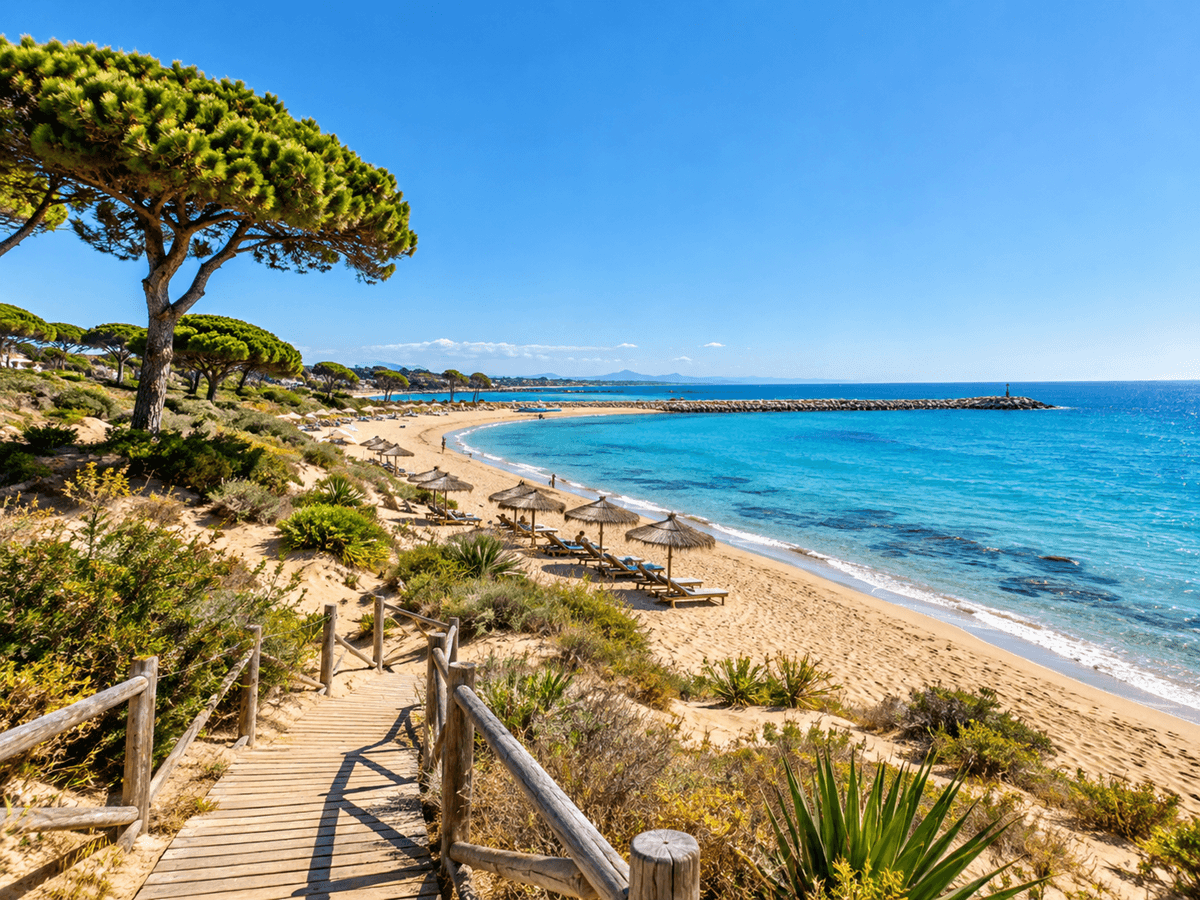
Cabopino Beach
The eastern side is generally calmer and more residential, and tends to appeal to buyers who want sea views and space without the pace of the Golden Mile.
Cabopino and Artola
The eastern edge of the municipality, with a small marina, a beach, natural dunes and a golf course. It has the most relaxed feel of the coastal strip.
What you’ll find here: apartments and townhouses in residential complexes, plus villas in the hills.
What’s around: the marina’s restaurants and the beach on foot, and Marbella’s main services a short drive west.
Las Chapas and Elviria
Residential hills above the A-7 with sea views, a long-established international community and several golf courses within a short drive, including Santa Clara and Higuerón.
What you’ll find here: villas, townhouse complexes and apartments in gated urbanisations, with a good share of recent new build.
What’s around: shops, supermarkets and restaurants nearby, with the beach and the town centre a short drive away. Most of the area is not walkable, so expect to drive.
Río Real and Los Monteros
One of the most established residential areas on the eastern side. Río Real has one of the longest-established golf clubs in the area, and Los Monteros has a beach a short drive east of the centre.
What you’ll find here: villas on mature plots, beachside apartment complexes and townhouses.
What’s around: the beach, golf and a handful of restaurants, with the full range of services in Marbella town.
Marbella town
Old Town and centre
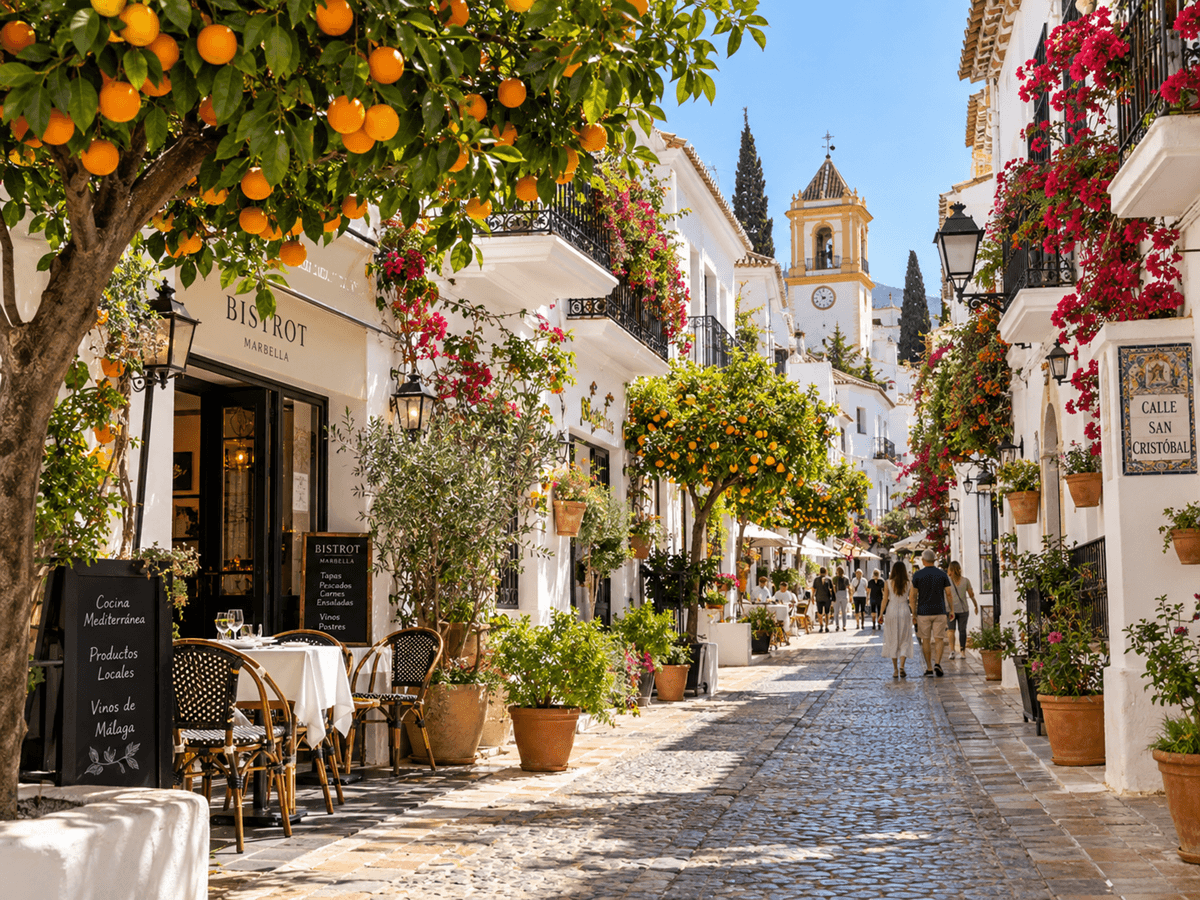
Marbella Oldtown
The most walkable part of the municipality, covered above. Mostly resale, and stock turns over quickly.
What you’ll find here: apartments and townhouses, from small flats to houses with a patio, and some new apartment blocks on the edges.
What’s around: everything, on foot. The beach, the Alameda park, the restaurants and the services.
The Golden Mile
The Golden Mile is an unofficial name rather than a formal district, and it is longer than a mile. It runs between Marbella town and Puerto Banús, and the term covers three distinct bands, which matter more than the name.
Beachside Golden Mile
The stretch between the sea and the old N-340 road, anchored by the Marbella Club and Puente Romano hotels. The highest-profile addresses in Marbella, with frontline positions and a premium for them.
What you’ll find here: a small number of beachside villas and frontline apartment complexes, almost all resale or in exclusive low-volume developments.
What’s around: the best-known restaurants and beach clubs in Marbella, the hotels and a short drive to both the Old Town and Puerto Banús.
Lomas de Marbella Club, El Vicario, Monte Paraíso and La Carolina
The middle band, between the coast road and the AP-7. Established gated urbanisations with mature gardens, a short distance from the beach and the hotels, and generally quieter than the front line.
What you’ll find here: apartments, townhouses and villas in large complexes, many of them with extensive communal facilities.
What’s around: the beach and the Golden Mile restaurants are within reach, with Marbella and Puerto Banús each a short drive away.
Nagüeles, Sierra Blanca and Cascada de Camoján
The northern band, above the AP-7 and into the foothills. Bigger plots, more privacy and sweeping sea views, in exchange for distance from the beach. Some people include Sierra Blanca in the Golden Mile, though it sits well back from the coast. Rocío de Nagüeles and Marbella Hill Club are among the best-known urbanisations here, and Swans International School is in the area.
What you’ll find here: mostly villas, plus apartment and townhouse complexes, with a good share of the new luxury construction in the municipality.
What’s around: very little on foot. You drive to the beach, the town and the shops, in a few minutes.
Nueva Andalucía and the Golf Valley
West of Marbella, behind Puerto Banús, and developed by José Banús from the 1960s. It is known as the Golf Valley because Las Brisas, Aloha, Los Naranjos and La Quinta are within a few square kilometres of each other. Aloha College is here, and it is a draw for families. Puerto Banús is a few minutes away, and the beach about the same by car.
What you’ll find here: apartments and townhouses in golf-side and gated complexes, and villas on larger plots. A broad price range, and a good share of recent new build.
What’s around: restaurants, supermarkets and services in the neighbourhood centres of Aloha and La Campana, with the beach and Puerto Banús a short drive away. It is the part of Marbella where families and golfers are most concentrated.
Puerto Banús
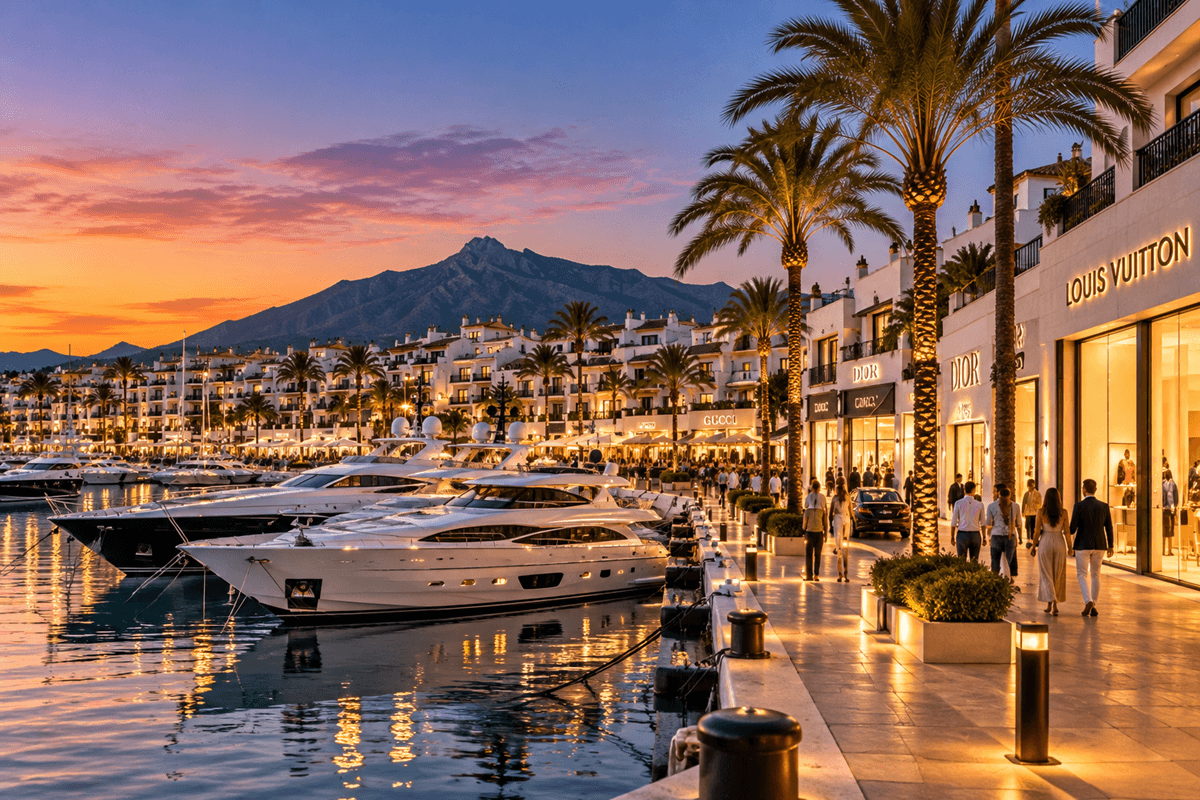
Sunset in Puerto Banus
The marina area, with apartments around the harbour and in the surrounding blocks. Lively, international and expensive to buy into per square metre, and it is loud in summer, so the specific street matters a great deal.
What you’ll find here: apartments and penthouses, mostly resale, with some new developments around the edges.
What’s around: the marina’s restaurants, boutiques and nightlife on the doorstep, the beach a short walk away and the Golf Valley a few minutes inland.
San Pedro de Alcántara and Guadalmina
The western end of the municipality, and in many ways the most residential. San Pedro is a town in its own right, with its own centre, its own fair and Holy Week processions, and a noticeably more local feel. Its beach is San Pedro de Alcántara (Guadalmina). International schools such as Laude San Pedro and Calpe School are here.
San Pedro centre
What you’ll find here: apartments and townhouses, a mix of resale and new build, at generally lower prices than the Golden Mile.
What’s around: daily shopping, services and restaurants within the town, with the beach a short walk or drive.
Guadalmina Baja and Guadalmina Alta
Guadalmina Baja is the beachside gated urbanisation, with large plots and direct beach access for many of the villas. Guadalmina Alta rises towards the Real Club de Golf Guadalmina, one of the longest-established golf clubs on the coast.
What you’ll find here: villas on mature plots, with apartments and townhouses in the complexes around the golf club.
What’s around: the golf club and beach on your doorstep, San Pedro for daily needs and Puerto Banús a short drive east.
The hills and the inland neighbours
Behind Marbella the Sierra Blanca separates the municipality from Ojén and Istán, which are separate municipalities with a rural village feel. La Zagaleta, a gated estate that many people think of as Marbella, is technically in Benahavís. It is a different market with its own rules and prices, and is covered in our Benahavís guide.
Luxury Villas for sale in Marbella

Almazara Views Marbella Istan
Almazara Views - Modern 3-bed townhouses in Istán, Marbella with…
Off Plan
620.000€

Villa Limón in Guadalmina Baja
Villa Limón is a stunning property boasting a unique design…
New Build
3.285.000€
Marbella FAQs
Which part of Marbella should I buy in?
This is the decision that shapes everything else, because very different realities sit under one name. The Old Town and centre are the most practical part to live without a car. The Golden Mile holds the frontline positions and the most recognisable addresses. Nueva Andalucía is where golf, schools and a settled international community come together. Puerto Banús is lively and international, and is better suited to people who want that energy. San Pedro and Guadalmina are the more residential, more local and generally better value end. The eastern side, from Río Real to Cabopino, suits buyers who want space and sea views at a slower pace. The question that settles it isn’t how much you want to spend, but how many weeks a year you will be here, and whether you want to be able to walk to things. We describe each area in more detail in the areas of Marbella.
What kind of property is for sale in Marbella?
Almost everything: apartments and penthouses in gated complexes, townhouses, villas of every size, and plots, as resale, new build and off-plan. The range is the appeal and the difficulty. Two properties at the same price can mean completely different lives depending on the district, so fix the area and the property type before you start viewing. You can see what we currently offer in our property for sale in Marbella.
Is Marbella expensive?
Yes. Marbella sits at the top end of the Spanish market, and it has kept rising through 2025. How expensive depends entirely on where: the gap between the beachside Golden Mile and the eastern hills or San Pedro is wide. If budget is the main constraint, the more useful question is which part of Marbella fits it, rather than whether Marbella as a whole does.
What’s the difference between new build, off-plan and resale?
In our experience, resale is the larger part of the Marbella market, and opens up the Old Town, the Golden Mile and the established urbanisations, with renovation as the variable. Off-plan means buying before or during construction, at a lower price and with payments spread across the build. Finished new build removes the wait and lets you see what you are buying, usually at a slightly higher price. On tax, new build and off-plan are charged VAT plus stamp duty, and resale is charged transfer tax.
How does buying off-plan work?
You sign a reservation contract, then a private purchase contract under which you typically pay between 20% and 40% of the price in stages during construction. The balance is paid on handover, before a notary. The law requires the developer to guarantee every payment made in advance through a bank guarantee or insurance policy, and to hold the money in an account separate from its own. Check that the guarantee exists and is in your name before you make the first payment. It is the thing most often overlooked and the thing that causes most problems.
How long does an off-plan development take to complete in Marbella?
There is no single answer, because it depends on the project and the phase you buy into. Most developments quote a completion window of roughly two years from the start of works, but what matters is the date written into the private contract, along with the consequences of delay. Go through it with your lawyer before signing, not afterwards.
What taxes and costs are involved?
New build is charged 10% VAT plus 1.2% stamp duty. Resale is charged 7% transfer tax. To that you add notary, land registry and your lawyer’s fees, which brings total costs to around 12 to 14% on new build and a bit less on resale. The rates are regional, so they are identical in Marbella, Estepona or anywhere else in Andalucía. None of it is included in the asking price, so budget for it from the start.
What are the running costs once I’ve bought?
Council tax (IBI), community fees and utilities. The community fee varies enormously in Marbella, from a modest block fee to very high charges in gated complexes with security, spa and extensive gardens. Always get the exact figure before signing, because it affects the return on the property more than almost anything else. If you are not a Spanish tax resident, there is also an annual non-resident income tax return on the property, whether you let it or not.
Is Marbella a good place to buy for rental income?
It is a very active rental market, long-term and holiday, but returns depend heavily on the area, the licence and the community rules, and nobody can promise a figure. For holiday letting you need to register the property with the Andalusian tourism register and obtain a VFT number. Marbella had not introduced a blanket freeze on tourist licences as of mid-2026, but recent changes to Spain’s horizontal property law and individual community statutes can still prevent it. Check the statutes and the minutes of recent owners’ meetings before buying with letting in mind.
Is it safe to buy resale in Marbella, given its planning history?
It can be, with proper checks. Marbella operated for decades under a 1986 plan, and a significant number of properties were built under licences that were later questioned. That is why a resale purchase here should always include a lawyer’s review of the urban status of the property, the licence of first occupation, the land registry entry and any pending charges. New build from a reputable developer, with its licences and guarantees in order, avoids most of this. The town’s new municipal plan, approved in September 2026, is expected to bring clearer rules over time.
Is Marbella somewhere you can live all year round?
Yes, and in our experience it is easy to do so. There is a large public hospital and private hospitals, international schools, daily shopping, golf and a restaurant scene that carries on through the winter. If you are weighing up a move rather than a holiday home, come and see it in winter before deciding. It tells you far more than an August visit.
Which international schools are nearby?
Marbella has a wide choice of international schools. In and around the municipality there are Aloha College in Nueva Andalucía, Swans International School in the Sierra Blanca area, the British International School of Marbella, the English International College on the eastern side, the German School in Marbella, and Laude San Pedro International College and Calpe School in San Pedro de Alcántara. Sotogrande International School is further west. Curricula and age ranges differ, so check each school’s current offer. For families relocating, the school usually decides the area before the property does.
How far is Marbella from the airport?
Málaga airport is approximately 50 to 60 kilometres away, around 45 to 50 minutes by the AP-7 toll road in normal traffic, and longer in summer or when the coast road is busy. Gibraltar airport is around 80 to 90 kilometres away, around an hour and a quarter, depending on the border. Málaga is the practical gateway for almost everyone.
Can a foreigner buy property in Marbella?
Yes, with no restrictions, resident or not. You will need an NIE, a Spanish bank account and, if you are financing the purchase, a non-resident mortgage, which Spanish banks grant routinely though at a lower percentage and with more paperwork than for a resident. Start that process alongside the reservation, because it takes longer than most people expect.
Marbella or Estepona?
In our experience, Marbella offers more services, a bigger name, more international schools and a more liquid resale market. Estepona offers more new build, a more compact feel and, in most comparable positions, better value per square metre, along with a town centre that still functions as a town twelve months a year. The gap narrows along the eastern side of Estepona, the New Golden Mile, where it meets Marbella, and the two compete for the same buyer there. Anyone torn between the two is usually deciding how much town and how much brand they want around them.
Off-plan Developments for Sale in Marbella

Altura Residence 4: Private 5-Bedroom Villa in La Quinta
Private villa in Altura Residences, La Quinta, Benahavís. 5 bedrooms,…
Off Plan
3.995.000€

Altura Residence 3: 5-Bedroom Villa in La Quinta, Benahavís
Villa in Altura Residences, La Quinta, Benahavís. 5 bedrooms, 196…
Off Plan
3.995.000€

Altura Residence 1: 5-Bedroom Corner Villa in La Quinta
Corner villa in Altura Residences, La Quinta, Benahavís. 5 bedrooms,…
Off Plan
4.250.000€

Luxury New Build Villa with Infinity Pool in La Quinta, Benahavís
Villa B at Tresora: a new build luxury villa with…
New Build
4.995.000€