If you’re thinking about buying a property in Andalucía to use for holiday rental, one of the first questions that probably comes to mind is how to get the tourist licence. This is an especially important question on the Costa del Sol, where many buyers consider combining personal use of a second home with renting it out during certain periods.
Before buying with tourist rental returns in mind, there’s something I consider essential: first checking whether that specific property can legally be used for that purpose. After more than fifteen years working in the Costa del Sol property market, I’m clear that an attractive, well-located property isn’t necessarily the right investment for every goal. Regulations, the community of owners and the property’s own characteristics also form part of the decision.
Let’s look at what you need to know and what you should check even before you buy.
What is the tourist licence in Andalucía?
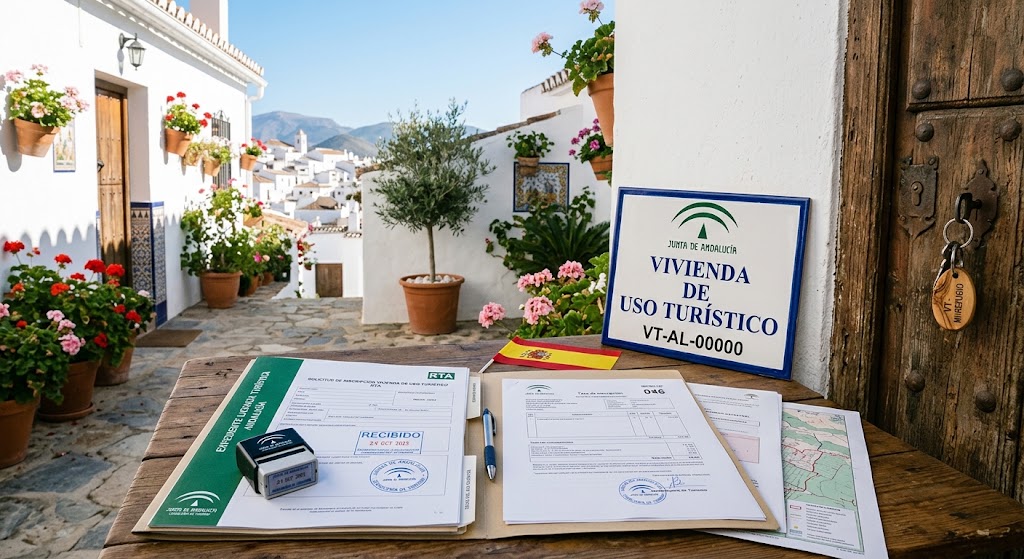
Although colloquially we talk about a “tourist licence”, the procedure for tourist-use dwellings (VUT) in Andalucía is actually built around a responsible declaration (declaración responsable) submitted electronically to the regional department responsible for tourism. There isn’t a licence that someone grants you: you declare that you meet the requirements, and the Administration checks afterwards.
Andalusian regulations define tourist-use dwellings as fully equipped homes ready for immediate use, where accommodation is offered for tourist purposes in exchange for payment and on a habitual basis. That purpose is presumed when the property is marketed or advertised through tourist booking channels.
A terminology note that confuses many buyers: until 2024 this figure was called “vivienda con fines turísticos” (VFT). Decree 31/2024 changed the name to “vivienda de uso turístico” (VUT). If you see the VFT acronym on a listing, a deed or an older certificate, it refers to the same thing.
What regulations govern tourist properties in Andalucía?
The core reference is Decree 28/2016, of 2 February, significantly amended by Decree 31/2024, of 29 January, and by Decree-Law 1/2025, of 24 February, on urgent housing measures.
These changes have strengthened urban planning compatibility, habitability conditions, obligations towards the community of owners, and the sanctions regime, which Decree-Law 1/2025 tightened considerably.
On top of this there’s an increasingly relevant municipal layer: several town councils are limiting or suspending new registrations. Málaga city suspended the granting of new licences across the whole municipal area, and I cover this in my article on the freeze on tourist licences in Málaga.
But you don’t need to go as far as the city. On the western Costa del Sol, Manilva has municipal restrictions in force on new tourist-use dwelling registrations. This isn’t a minor case: according to data from the Territorial Delegation for Tourism that the town council itself used when addressing its regulation, Manilva has 2,394 registered tourist-use dwellings with 12,686 beds — a density that explains the decision.
If you’re considering a purchase in Manilva with the intention of renting it out, confirm the exact scope and current validity of the restriction with the town council before signing anything. I go into detail in my article on tourist rental licences in Manilva.
This has a direct consequence for a buyer: two almost identical apartments, one in Manilva and another ten minutes away in Casares, can have completely different futures as a tourist investment. And the listing won’t tell you that.
For a buyer, the summary is this: don’t assume a property can be used as tourist accommodation simply because other properties in the same town are rented that way. The municipality, the building and the property itself all matter — and so does the date the neighbouring property was registered.
Requirements for a tourist property in Andalucía
Before submitting the responsible declaration, you need to check that the property meets the required conditions.
Current requirements include compliance with municipal urban planning regulations. The dwelling must generally have a minimum built area of 25 m² for main use and at least 14 m² built per bed space. There are also requirements relating to the number of bathrooms according to capacity, ventilation of bedrooms and living rooms, blackout systems, furniture, equipment, utilities, and all the elements needed for the property to be used immediately.
Capacity isn’t unlimited either. Whole-property rentals can’t exceed fifteen bed spaces; in the room-by-room model the general maximum is six, with no more than four bed spaces per room.
So this isn’t simply a matter of furnishing an apartment and listing it on a platform.
The community of owners: the point that blocks the most purchases
This is the aspect I’d check before buying, not after, and it’s the one that has changed the most.
Since 3 April 2025, article 17.12 of the Horizontal Property Law, reformed by Organic Law 1/2025, requires express approval from the owners’ association (junta de propietarios) to use a property for tourist purposes. A simple majority isn’t enough: it requires a favourable vote from three-fifths of all owners, who in turn must represent three-fifths of the participation quotas.
At the same time, Andalusian regulations require the responsible declaration to state that tourist use isn’t prohibited in the property’s title deed or the community’s bylaws, and that this authorisation exists. Among the documentation the Junta currently specifies is an updated simple note (nota simple) from the Land Registry and a certificate from the community’s secretary or administrator confirming the express, current approval.
This significantly changes how a purchase aimed at holiday rental should be approached. Three-fifths isn’t achieved at just any meeting, and in communities with many resident owners it’s common for it not to pass. If tourist rental is an essential part of your strategy, don’t buy first and ask questions later.
A common question: if the property is already registered and operating from before April 2025, the situation isn’t the same as a new registration. This is a point worth confirming case by case with the community administrator and a lawyer before assuming anything, because interpretations aren’t uniform.
I’ve detailed the preliminary checks in my guide on tourist rentals in Andalucía: what to check before investing.
The national register: what happened to the NRUA
This is worth clarifying, as for more than a year it was treated as mandatory.
Royal Decree 1312/2024 created a Single Rental Register and a registration number (NRUA or NRA) that platforms were required to display and verify from 1 July 2025. The Supreme Court annulled that procedure in May 2026, ruling that the State lacked the authority to create a national register overlapping with the regional ones.
In practice: the register that matters in Andalucía is the regional one, the Registro de Turismo de Andalucía. If you registered for the NRUA at the time and incurred costs for it, it’s worth checking this with your advisor. And since this area has moved a lot in a short time, always check the current status before making a purchase decision.
How to obtain the tourist licence, step by step
1. Check the property’s viability
The process starts before submitting any form. You need to confirm that the property complies with applicable regulations and that tourist use is compatible with urban planning rules, as well as reviewing the land registry situation and the community of owners’ conditions.
This preliminary check is especially important when you haven’t bought yet. If you’re looking for property with an investment goal, my analysis of the new legal framework for tourist rentals in Spain explains the general context.
2. Prepare the documentation
This will depend on each situation, but the Junta currently identifies, among other documents, the updated simple note and the community certificate. If the person operating the property isn’t the owner, the legal title allowing that operation must be evidenced. There are also specific documents for cases of co-ownership, representation, or room-by-room rental.
3. Submit the responsible declaration
To begin offering accommodation, the responsible declaration must be submitted electronically. It includes the property’s identification and cadastral reference, maximum capacity, the operating person or entity, the owner when different, urban planning compatibility, the situation regarding the community of owners, and the periods during which the service will be provided.
4. Registration in the Registro de Turismo de Andalucía
The responsible declaration is linked to the property’s registration in the Registro de Turismo de Andalucía. The Junta has a public search tool that lets you locate registered properties, which is also useful for checking the real status of a property you’re considering buying.
Whether the declared information is correct isn’t a minor detail. Essential falsehood or inaccuracy, failing to continue meeting the required conditions, or lacking certain authorisations can lead to cancellation of the registration following the corresponding procedure.
Can I buy any property on the Costa del Sol to rent it out to tourists?
I would never take this for granted, and this is probably the most important piece of advice in this guide.
If you’re looking for a property specifically with holiday rental in mind, the possibility of operating it as tourist accommodation should be part of the due diligence before buying. You need to study the property, but also the community and the urban planning and administrative conditions.
I work with buyers looking for a primary residence, a second home, and investment. These are three different goals that can lead to completely different properties. The same applies to location: Marbella, Estepona, Benahavís, Sotogrande, Casares and Manilva have different markets and demand profiles. And as I explained above, Manilva also has municipal restrictions that are worth checking before buying with the intention of renting.
The licence isn’t the only thing that matters
The fact that a property can legally be used as a tourist dwelling doesn’t mean it’s a good investment. These are two separate questions: whether you can legally rent it out, and whether doing so makes economic sense.
For the second question, you need to consider the purchase price, expenses, the community, maintenance, management, taxation, occupancy seasons, existing competition, and the visitor profile.
It’s also worth thinking about the future. If in five years’ time you decide to stop renting it out, would it still be a good second home? Would there be demand to sell it? Regulations have changed three times in two years and could change again, so the property should also hold up without rental income.
Before buying, check; then decide
I wouldn’t buy a property based solely on the agent, owner or listing stating that it’s “ideal for tourist rental”. It needs to be verified: check the urban planning situation, review the simple note, study the community’s bylaws and agreements, and confirm the tourism requirements before committing to an investment.
In my way of working, I always prefer to start with the real use you want to give the property, and then look for a property that fits that goal. Under current regulations, doing it the other way round gets expensive.
Looking for a property on the Costa del Sol?
If you’re considering a property in Marbella, Estepona, Benahavís, Sotogrande, Casares, Manilva or La Alcaidesa as a second home or investment, tell me exactly what you’re looking for. I can help you find a property that fits your goal and coordinate the process with the relevant legal and tax professionals.
Frequently asked questions about the tourist licence in Andalucía
Is a tourist licence mandatory to rent out a property in Andalucía?
When a property fits the definition of a tourist-use dwelling and is marketed as such, it must comply with the applicable regime and the corresponding responsible declaration must be submitted for registration in the Registro de Turismo de Andalucía.
Where do you apply for it?
The process is carried out electronically before the Junta de Andalucía’s department responsible for tourism, via a responsible declaration. The forms and access points are available on the official tourist-use dwellings portal.
What majority do I need in the community of owners?
Since 3 April 2025, article 17.12 of the Horizontal Property Law requires a favourable vote from three-fifths of the owners, representing three-fifths of the participation quotas. This is an essential requirement that must be checked before buying.
What minimum size does a tourist property need?
Generally, a minimum of 25 m² built for main use and 14 m² built per bed space, without prejudice to what the applicable urban planning regulations determine.
Is the NRUA still mandatory?
No. The Supreme Court annulled the single rental register procedure under Royal Decree 1312/2024 in May 2026. In Andalucía, the applicable register is the regional one.
Can I register a tourist property in any municipality?
No. Besides regional regulations, some town councils have suspended or restricted new registrations: Málaga city and Manilva are two examples, and the list may grow. Checking the situation in the specific municipality is the first thing I’d do before buying with the intention of renting.
Is it a good idea to buy a property for tourist rental on the Costa del Sol?
It can be, but the licence is only part of the analysis. Before buying, you need to check legal viability and study price, location, demand, expenses, competition and the property’s potential. Future returns should never be taken for granted.