Buying a property with tourist rental in mind can look like an easy decision: good location, attractive home, strong international demand and promising returns. In 2026 it is no longer enough for a home to look commercially attractive. Before you reserve, you need to check the legal, registration and community side of the purchase, and you need to do it in the right order.
This is my checklist for buyers. It is about deciding whether to buy. If you already know the property works and want the procedure, read how to obtain the tourist licence in Andalucía, and for the wider rules see the tourist rental rules in Spain. Reviewed on 25 October 2026. I am an agent, not a lawyer, so have a lawyer confirm the points that decide your purchase.
Why the order matters
A few years ago many buyers sorted out the tourist side after completion. Today that is the risky way round. Between the Andalusian register, community rules that now need a qualified majority, municipal suspensions and stronger controls, the sensible order is to check everything before you sign. The national single register, which many websites still describe as in force, was annulled by the Supreme Court in May 2026, so do not rely on older articles, including some of mine from before that date.
The seven checks I would make before reserving
1. Is the property registered, and on what terms?
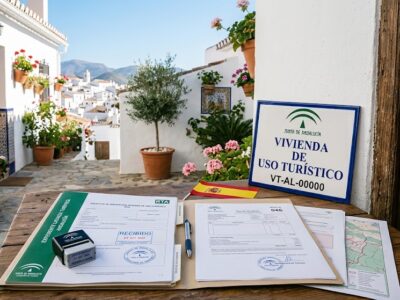
In Andalusia, tourist-use properties are registered in the Registro de Turismo de Andalucía. The Junta has a public search tool. If the seller says the property “has a licence”, look it up and ask for the registration number and the documents behind it. The Junta removed more than 13,000 dwellings from its register in early 2026, according to the regional press, so a past registration proves little.
2. What do the community statutes say?
Since 3 April 2025, starting tourist use needs the favourable vote of three-fifths of the owners, who must also represent three-fifths of the quotas. Ask for the statutes, the latest minutes and any pending proposals. If a community has already restricted tourist lets, that is the end of the plan, whatever the town hall says.
3. What does the town hall allow?
Municipalities can suspend new tourist licences for up to three years. Málaga city has, and so has Manilva in several areas. Ask the specific town hall in writing, because the position can differ between two neighbourhoods of the same town.
4. Does the property meet the physical requirements?
Minimum built area, bathrooms for the declared capacity, ventilation, furnishings and urban planning compatibility. A new build usually meets these on paper, but ask for the documents.
5. What is the history of the property?
“It has always been rented to tourists” does not guarantee the future. Ask whether it was properly registered, whether there were complaints or disputes and whether the community has changed its position.
6. Do the numbers work without daily lets?
This is the check most buyers skip. If the purchase only works with tourist letting, it depends on a rule you do not control. Test it as a seasonal or long-term let too, bearing in mind the October 2026 decrees, which are pending validation. See tourist rental or traditional rental and Spain’s new rental law 2026.
7. Does the home still work if you never rent it?
Regulations have changed three times in two years. The home should be one you would be happy to use, or to sell, without the rental income.
Red flags
- The listing says “ideal for tourist rental” and offers no registration number.
- The agent or seller will not let you see the statutes and minutes.
- The yield figure assumes full-year high-season occupancy.
- The developer cannot say what the community will decide on tourist use. See how to judge a developer’s reputation.
- You are asked to reserve before the legal checks are done.
The area matters too, not only the law
Even where tourist use is legal, a property does not perform the same in every area. In Estepona, the beach, the promenade and daily services carry the most weight. In Benahavís the appeal is privacy, golf and quieter stays. In Casares or Manilva, the landscape, entry price and guest profile play a different role, and in Manilva the municipal restrictions come first. In my Costa del Sol market guide, asking rents for the main towns run from about €15.57/m² a month in Málaga city to €18.28/m² in Estepona, with implied gross yields around 5.3% to 5.7% before costs and taxes, and for Torremolinos the guide itself notes that the 6% to 8% sometimes quoted locally needs buying below average or short-term letting, with higher costs and regulatory risk.
New build and off-plan: the advantage and the catch
With a new development you can ask the developer and the community before you reserve whether tourist use is planned, restricted or still undecided. The catch is that statutes are often drafted before the owners arrive, so read them. The rental potential of new builds explains how I look at it.
The new 10% VAT on short stays from 1 December 2026
From 1 December 2026, lettings of furnished apartments or homes for stays of up to 30 nights stop being exempt from VAT and are taxed at 10%, unless the property is the owner’s habitual residence. This comes from article 7 of Royal Decree-Law 29/2026, it appears in the Spanish Tax Agency’s VAT updates, and Congress validated the decree on 12 November.
- A furnished home let for up to 30 nights to the same guest: 10% VAT.
- Stays of more than 30 nights: outside this change, generally treated as before.
- The owner’s habitual residence: excluded from the new VAT.
Before buying, I would check three things. First, whether the price you plan to advertise already includes VAT: if it does not, the guest pays it, and if it does, it comes out of your income. Second, how bookings and deposits taken before 1 December for later stays will be treated, because the official text I checked does not say, so it is worth asking your tax adviser. Third, what input VAT you might be able to deduct on costs and furnishings, which depends on each case and which I would not take for granted.
With a general election on 29 November 2026, I cannot rule out later changes. As things stand, the measure applies from 1 December.
Due diligence should go further than in a standard purchase
At the least, I would review the Land Registry extract, the statutes and resolutions, the viability of tourist use at regional, municipal and community level and the property’s real fit with the short-stay market in that area and how the new 10% VAT on short stays affects your numbers. I work with independent lawyers, and you can read how I suggest choosing a Spanish lawyer. In this kind of purchase, the legal review is part of the investment analysis, not an optional extra.
Thinking of buying with tourist rental in mind?
Tell me the town, your budget and how you plan to use the property, and I will tell you honestly which of these checks is most likely to stop it. Contact me here, or see my properties for sale in Estepona.
Sources: Costa del Sol Property Market Guide 2026 (The Property Agent), with data from Idealista, Tinsa and Engel & Völkers; Junta de Andalucía figures reported by the regional press (8 February 2026). Spanish Tax Agency, VAT updates 2026 (Real Decreto-ley 29/2026, article 7; BOE-A-2026-20823).