
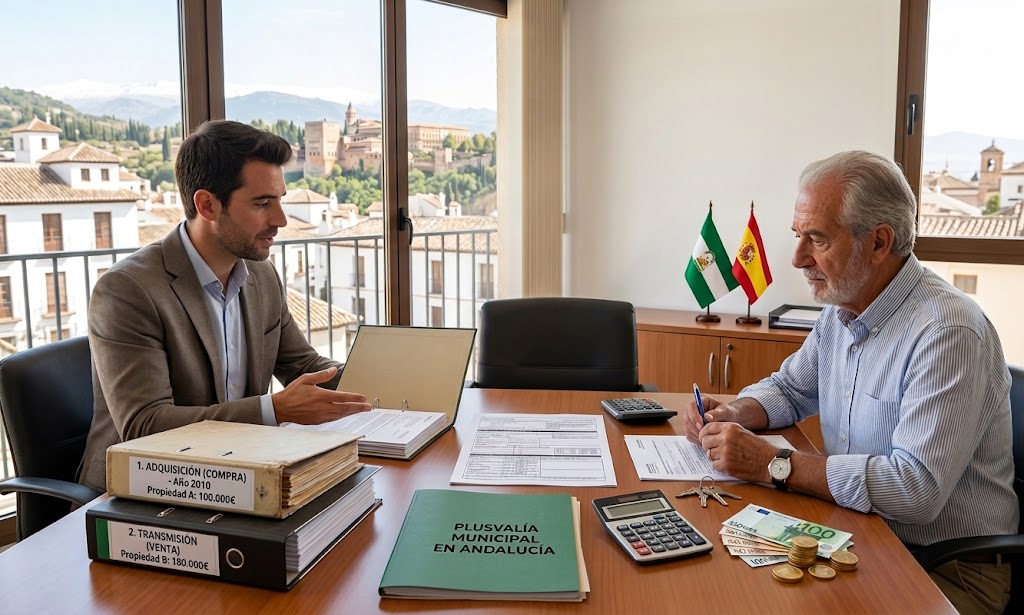
You’re going to sell your property for a higher price than you paid for it, and you start doing the maths: sale price, outstanding mortgage, fees, expenses. And then an item appears that’s often overlooked: the plusvalía municipal.
Its official name is quite a bit harder to remember — Impuesto sobre el Incremento de Valor de los Terrenos de Naturaleza Urbana (IIVTNU), or Tax on the Increase in Value of Urban Land — and it’s regulated in the consolidated text of the Law Regulating Local Treasuries (Royal Legislative Decree 2/2004). It’s a municipal tax that taxes the increase in value experienced by urban land when it’s transferred. In other words, it doesn’t tax how much your house has gone up in price, but the increase corresponding to the land itself.
After more than fifteen years working in real estate, one of the things I consider important when preparing a sale is looking beyond the price that will appear in the listing. The owner needs to understand roughly what they’ll be left with after the transaction, and that’s where taxes and costs like this one come in.
What is the municipal capital gains tax on a property?
The plusvalía municipal is a local tax, meaning it’s managed by the town council of the municipality where the property is located. The law establishes that it taxes the increase in value experienced by urban land when that increase becomes apparent through the transfer of ownership or certain real rights.
There’s a detail worth being clear about from the start: the tax relates to the land, not the construction. That’s why the cadastral value of the land matters so much when calculating using the objective method, and why two properties of similar price can generate very different tax bills.
Plusvalía can arise in different types of transaction: sales, inheritances, gifts, and certain transfers of real rights. Land classified as rustic for IBI (property tax) purposes, on the other hand, isn’t subject to this tax.
Who pays the municipal capital gains tax when selling a property?
In a normal sale, the person liable for payment is the seller. If you bought an apartment in Estepona and now decide to sell it, as a general rule you, as the transferor, will be the one who has to cover the plusvalía if the transaction is subject to it.
In an inheritance or gift, the situation changes. When the transfer is free of charge, the taxpayer is whoever acquires the land or receives the right — the heir or the recipient of the gift, as applicable.
There’s also a very relevant particularity in markets like the Costa del Sol. If the person transferring the property for consideration is a non-Spanish-resident individual, the law establishes that the buyer acts as substitute taxpayer. In practice this means the buyer becomes liable to the town council, although they may later be able to claim the amount back from the seller as agreed. This is one of the reasons why, when I’m supporting a transaction involving international owners or buyers, I consider it especially important for the tax position to be reviewed by the relevant professionals before signing, and for it to be set out in writing in the arras contract (deposit agreement).
When is the municipal capital gains tax paid?
The general legal deadlines depend on the type of transfer. For inter vivos transactions, such as a sale or a gift, the deadline is thirty working days from the date the tax accrues. For transfers due to death, the deadline is six months, extendable to one year on request.
Each town council manages the tax according to its own bylaw within the framework of national legislation, and some municipalities work on a declaration basis while others require self-assessment. So if you’re selling a property in Marbella, Estepona, Manilva, Casares or any other Costa del Sol municipality, I recommend checking the specific procedure with the relevant town council. I wouldn’t leave this check for months after signing.
A point that’s often forgotten: even if the transaction isn’t subject to the tax because there’s no increase, many town councils still require the declaration to be submitted within the deadline. Failing to do so can lead to a penalty even if there was nothing to pay.
How is the municipal capital gains tax on a property calculated?
This is probably the part that raises the most questions. Since the 2021 reform, the system allows two ways of determining the taxable base: the objective method and a calculation based on the real increase, when this is lower. The taxpayer can choose whichever is more favourable to them.
Objective method
In simplified terms, the objective method starts from the cadastral value of the land the property has at the time of transfer. This shouldn’t be confused with the property’s market price. The basic formula is:
Cadastral value of the land × coefficient corresponding to the generation period = taxable base
The tax rate set by the town council, which can’t exceed 30%, is then applied to that base. The coefficients depend on the period over which the increase was generated and are updated every year through the State General Budget Law, precisely to reflect how the property market is evolving. The maximum period considered under this system is twenty years.
Another reform change worth knowing: transfers occurring less than a year after acquisition are now also taxed. Previously they fell outside the tax, which was relevant for people who bought off-plan and resold before completing the deed.
Because of all this, I can’t tell you how much plusvalía you’ll pay just from knowing you’re going to sell a house for €500,000. We’d need to know, among other things, the cadastral value corresponding to the land, how long you’ve owned the property, and the municipality’s bylaw.
Method based on the real increase
There’s a second option, especially important when the market hasn’t cooperated. If the increase in value that genuinely corresponds to the land is lower than the base resulting from the objective method, the taxpayer can request that this lower increase be used as the taxable base, provided it can be evidenced according to the legal rules.
Simplifying considerably: the transfer value is compared with the acquisition value, and the portion of that increase attributable to the land is determined by applying the proportion between the cadastral value of the land and the total cadastral value.
It’s worth calculating both results before settling the tax. I wouldn’t automatically assume the objective method is the more favourable one, especially for properties bought close to the market’s previous peak.
Simple calculation example
Let’s imagine a property whose total cadastral value is €150,000, of which €60,000 corresponds to the land, and let’s assume the applicable coefficient for the generation period is 0.15.
Under the objective method, the taxable base would be €60,000 × 0.15 = €9,000. If the town council applied a rate of 25%, the resulting tax bill would be €9,000 × 25% = €2,250.
But don’t use these percentages to calculate your own property. The coefficients change every year, and the rate depends on the municipal bylaw in force at the time of transfer. This example is only meant to help you understand the mechanics.
Do I have to pay plusvalía if I sell at a loss?
Not necessarily. This was actually one of the major historical problems with the tax, and the reason behind its reform.
Current legislation provides for non-liability when it’s established that there has been no increase in the land’s value between the acquisition and transfer dates. But it isn’t enough to simply say you’ve lost money: the taxpayer must prove there’s been no increase by providing the deeds documenting both the acquisition and the transfer.
It’s also important to distinguish between an overall loss on the transaction and the specific rules the IIVTNU uses to determine the increase in the land’s value. It’s possible to lose money on the sale and still have an increase attributable to the land. That’s why, if you bought at a similar or higher price to the one you’re selling at, it’s especially worth reviewing the situation before settling the tax.
Reductions: the case of inheritance
Municipal bylaws can establish reductions of up to 95% of the tax bill on transfers due to death of the deceased’s habitual residence, when the acquirers are the spouse, descendants or ascendants.
This is a discretionary reduction: each town council decides whether to apply it, at what percentage, and under what requirements, which usually include a minimum period of retaining the property. In the case of an inheritance, it’s worth checking this before settling the tax, as the difference can be considerable.
Plusvalía municipal and IRPF: they aren’t the same tax
This confusion is very common. When we sell a property, two different tax matters can arise.
On one hand there’s the plusvalía municipal (IIVTNU), a local tax related to the increase in value of urban land. On the other, there’s the possible capital gain arising from the sale, which can have consequences for IRPF (personal income tax) when the seller is liable for that tax, or for IRNR (non-resident income tax) when they aren’t a tax resident in Spain. They aren’t the same thing and aren’t calculated the same way.
Nor should the plusvalía be confused with IBI (property tax) or with the taxes the buyer faces. If you want to understand the overall taxation of a transaction, you can check my guide on taxes when buying a property in Spain, and, if the purchase is a new-build, my article on AJD in Andalucía.
How much will I pay for selling my house?
There’s no single figure for the whole of Spain, and it can’t be calculated purely from the sale price either. Among the details worth having to hand are:
- The municipality where the property is located.
- The date and value of acquisition.
- The date and value of transfer.
- The total cadastral value.
- The cadastral value corresponding to the land.
- The municipal tax bylaw in force.
- The period during which you’ve owned the property.
With this information, you can study which method applies and which may be more favourable. That analysis is part of something I consider fundamental before selling: calculating the transaction based on the net result, not just the sale price.
Selling a property on the Costa del Sol
In this area there’s a practical particularity: I work continuously with owners of different nationalities and with people who aren’t tax residents in Spain. A property in Marbella won’t necessarily have the same circumstances as one in Estepona, Manilva, Casares or San Roque. The plusvalía is municipal and the bylaws matter, but the seller’s personal situation matters too.
That’s why, when I prepare a property to go on the market, I prefer the owner to know the main financial elements of the transaction from the start. It doesn’t make much sense to think “I bought for 300,000 and I’m going to sell for 450,000, so I’ve made 150,000”. Between those two figures there can be costs, taxes and tax circumstances that considerably change the final result.
What to check before selling
Before signing a deposit agreement or getting to the notary, I’d try to have all the necessary information ready to properly estimate the transaction. I’d locate the acquisition deeds, check the transaction values, review the latest IBI receipt, and confirm the cadastral value corresponding to the land, which is itemised on the receipt itself. Then I’d check the applicable regulations and municipal bylaw.
And especially when there are non-residents, inheritances, gifts, multiple owners or particular tax situations involved, I’d ask the lawyer or tax advisor to confirm the specific treatment. I can support you with the real estate side of the sale and coordinate the process with the relevant professionals when needed, but settling the tax itself is a matter for a tax advisor.
Alongside all this tax side, it’s worth working on the property’s presentation, and that’s why I wrote a guide on how to prepare your house for sale.
Selling with the numbers clear
The plusvalía municipal is one of those concepts that seems complicated until you understand what it’s actually taxing. It doesn’t tax the profit you’ve made selling your house: it taxes the increase in value of the urban land revealed by its transfer, and it’s managed at municipal level.
Before selling, it’s worth checking whether the transaction is subject to it, who has to pay, what the land’s cadastral value is, and what result the two calculation methods produce. It’s the same philosophy I use when working on a purchase: it isn’t just about finding a buyer or a property, but about properly understanding the transaction behind it. I prefer these figures to be known before signing, not once the deal is already closed.
Are you considering selling a property on the Costa del Sol?
If you have a property in Marbella, Estepona, Benahavís, Sotogrande, Casares, Manilva or La Alcaidesa, get in touch and let’s look together at the real estate side of your transaction and the next steps.
Frequently asked questions about the municipal capital gains tax
Who pays the municipal capital gains tax when selling a house?
As a general rule, in a sale it’s paid by the seller. There’s a particularity when the transferor is a non-Spanish-resident individual: in that case, the law establishes that the buyer acts as substitute taxpayer.
How long do I have to pay the plusvalía after selling?
For inter vivos transfers, the general legal deadline is thirty working days. For transfers due to death, it’s six months, extendable to one year on request.
Is the municipal capital gains tax calculated on the sale price?
Not directly. The objective method uses the cadastral value of the land and the coefficient corresponding to the generation period, which is updated annually. There’s also the possibility of determining the base according to the land’s real increase in value when this is lower and can be evidenced under the regulations.
Do I have to pay plusvalía if I’ve sold the property at a loss?
If it’s proven that there’s been no increase in the land’s value, the transfer isn’t subject to the tax. The acquisition and transfer deeds need to be provided to demonstrate this, and many town councils still require the declaration to be submitted even if there’s no tax due.
Are there reductions in the case of inheritance?
Municipal bylaws can apply reductions of up to 95% on transfers due to death of the deceased’s habitual residence in favour of the spouse, descendants or ascendants. This is at each town council’s discretion, so you need to check the specific bylaw.
Are municipal capital gains tax and capital gain the same thing?
No. The plusvalía municipal is the IIVTNU and falls under local jurisdiction. The capital gain arising from the sale is a different tax concept that can have consequences for IRPF or IRNR depending on the seller’s circumstances.
Where is the municipal capital gains tax paid?
It’s managed by the town council corresponding to the municipality where the property is located. The specific declaration or self-assessment procedure needs to be checked against the municipal bylaw in force.