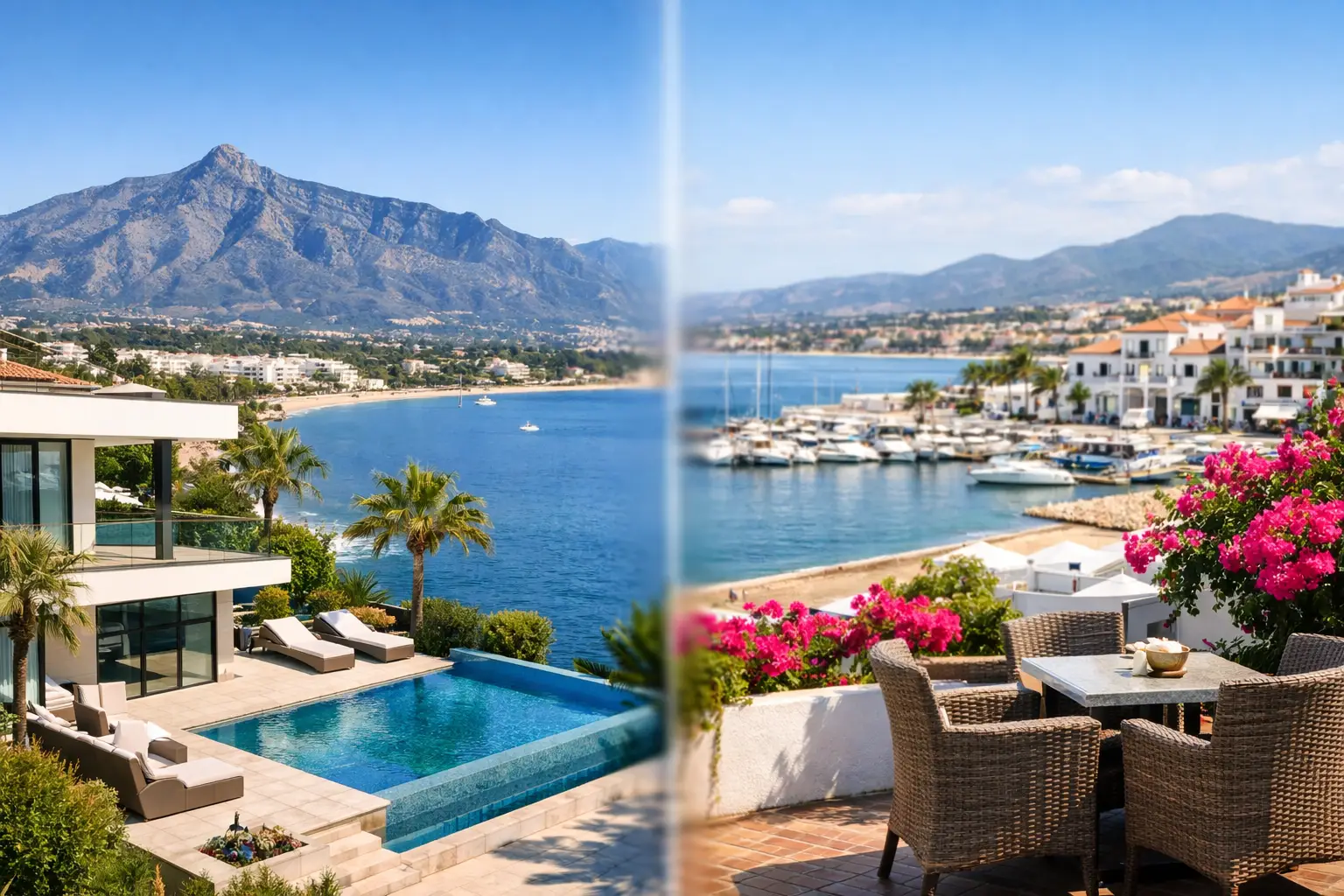
For many buyers, the Marbella vs Estepona property decision comes down to one question: do you want immediate prestige, or a little more space to grow? Both markets sit on the Costa del Sol’s most desirable stretch, both offer beach, golf and year-round lifestyle appeal, and both attract international demand. Yet they feel very different once you look beyond the brochure images.
This is not simply a choice between two neighbouring towns. It is a choice about pace, profile, stock, pricing and long-term strategy. For a second-home buyer, that shapes how you live. For an investor, it shapes entry point, rental performance and future resale appeal.
Marbella vs Estepona property: the key difference
Marbella is the Costa del Sol’s established luxury benchmark. It has global recognition, prime postcodes, a stronger concentration of ultra-premium homes and a social profile that remains hard to match anywhere on the southern Spanish coast. Buyers are often drawn by address value as much as by the property itself.
Estepona, by contrast, has evolved into one of the most compelling growth stories in Southern Spain. It still offers refined lifestyle appeal, but with a calmer atmosphere, excellent new-build supply and, in many cases, better value per square metre. For buyers who want contemporary homes, modern communities and a market with room for upward movement, Estepona often enters the conversation very quickly.
Neither is universally better. The right choice depends on whether your priority is prestige, family living, rental demand, modern stock or price sensitivity.
Lifestyle and setting
Marbella delivers energy. The town centre, the Golden Mile, Puerto Banus and the surrounding residential enclaves create a layered lifestyle that ranges from polished old-town charm to beach clubs, fine dining and private international living. It suits buyers who want to be close to established social infrastructure and who place a premium on visibility, convenience and status.
Estepona feels more relaxed and more understated. Its old town is beautifully maintained, the seafront is broad and walkable, and many of its residential areas are designed around comfort rather than profile. It appeals to buyers who still want quality and elegance, but without the busier rhythm associated with Marbella’s best-known areas.
That difference matters more than many expect. A purchaser planning frequent holidays may prefer Marbella’s immediacy and variety. A family spending longer periods in Spain may find Estepona easier to live in week after week.
Who tends to prefer Marbella?
Marbella usually attracts buyers who value prime branding, established luxury neighbourhoods and strong international recognition. It is especially compelling for those looking at the Golden Mile, Sierra Blanca, Nueva Andalucia or beachside addresses where demand remains resilient across market cycles.
It also suits purchasers who want a wider luxury ecosystem around them – top restaurants, marinas, designer retail, leading golf clubs and a strong high-net-worth community.
Who tends to prefer Estepona?
Estepona often appeals to buyers who want a more measured atmosphere, newer developments and a stronger balance between lifestyle and value. It has become particularly popular with international purchasers seeking modern flats, penthouses and gated communities close to the sea or golf courses, but without Marbella pricing at the point of entry.
For many, it feels polished rather than showy. That can be a major advantage.
Property stock and what your budget buys
One of the biggest practical differences in the Marbella vs Estepona property comparison is stock type.
Marbella has a broad range, but its most sought-after areas often centre on established villas, premium resale homes, renovated Andalusian properties and high-end contemporary schemes where pricing already reflects the location’s maturity. New developments do exist, particularly in Nueva Andalucia, San Pedro’s surroundings and east Marbella, but prime supply is naturally more constrained.
Estepona has seen extensive development over recent years, particularly in the new-build segment. Buyers will find a larger pipeline of contemporary flats, penthouses, townhouses and secure communities with pools, gyms, wellness areas and sea views. For clients focused on off-plan opportunities, Estepona often presents more choice and a clearer route into modern stock.
This affects budget efficiency. In broad terms, the same budget that buys a good quality new-build flat in Marbella may secure a larger home, better communal amenities or a stronger position within a development in Estepona. At the upper end, Marbella still commands stronger price ceilings, but Estepona increasingly attracts premium buyers as its product improves.
Investment outlook and capital growth
Marbella remains one of the Costa del Sol’s most proven markets for long-term desirability. Its brand power is international, and that gives it defensive strength. Prime homes in the right areas tend to benefit from consistent demand, especially when they offer privacy, design quality and proximity to the beach, golf or Puerto Banus.
Estepona’s investment case is slightly different. It is driven less by historic prestige and more by momentum. Public realm improvements, a more refined town centre, strong developer interest and increasing buyer demand have lifted its profile considerably. For investors who want to enter a market that still feels as though it has room to mature further, Estepona can look particularly attractive.
There is, however, a trade-off. Marbella’s best addresses may offer stronger prestige-led resilience, while Estepona may offer a more appealing entry point and, in selected areas, sharper growth potential from today’s values. It depends on your timeframe and risk appetite.
Off-plan versus established resale
If your strategy focuses on off-plan, Estepona often stands out. The volume of quality new developments is higher, and many schemes are built around what international buyers actually want – open-plan interiors, generous terraces, energy efficiency, secure parking and resort-style amenities.
If your strategy is centred on prime resale in a globally recognised location, Marbella has an edge. There is a depth of established prestige there that cannot be manufactured quickly.
Rental demand and buyer profile
Marbella has a very strong short-let profile in the correct locations. Areas close to the Golden Mile, Puerto Banus, golf valleys and premium beach zones remain highly attractive to holiday tenants willing to pay for location and image. For owners looking at high-end seasonal demand, Marbella is often the more obvious choice.
Estepona also performs well in the rental market, especially for modern seafront or golf properties and family-friendly developments with facilities. Its appeal is often broader and slightly less image-driven. Tenants looking for quality, value and a calmer base are increasingly open to Estepona, especially as the town’s reputation continues to strengthen.
For longer stays and medium-term occupancy, Estepona can be very compelling. For peak-season luxury short lets, Marbella often carries stronger headline appeal.
Practical living, connectivity and everyday use
Both locations benefit from strong access to Malaga Airport, respected golf courses, international schools and healthcare. The practical difference is less about infrastructure and more about rhythm.
Marbella is busier, more socially active and more varied from one district to another. That can be a benefit if you want movement and choice on your doorstep. It can also feel more crowded in peak periods, particularly in the most famous enclaves.
Estepona tends to offer an easier daily pace. Traffic pressure is often lighter, the promenade and town centre feel more manageable, and newer residential zones are often designed with everyday living in mind. Buyers planning extended stays or eventual relocation often notice this quickly.
So, should you buy in Marbella or Estepona?
If you are buying for prestige, global recognition and prime luxury positioning, Marbella is difficult to beat. It remains the stronger name, and in property that matters. If your aim is to own in a market with established cachet and deep international demand, Marbella makes a very persuasive case.
If you are buying for modern living, value relative to quality and access to strong new-build opportunities, Estepona deserves serious attention. It combines lifestyle appeal with a more comfortable point of entry in many segments, and that balance is exactly why it has become one of the Costa del Sol’s standout markets.
For some buyers, the answer is simple. For others, it comes down to micro-location, property type and budget deployment rather than town name alone. A frontline beach penthouse in Estepona and a hillside villa in Marbella are not competing for the same buyer, even if they sit within the same regional search.
The smartest approach is to treat Marbella and Estepona not as rivals, but as two distinct luxury markets with different strengths. When the property, location and strategy align, either can be an excellent purchase. The real advantage comes from choosing the one that fits the way you want to live – and the way you want your investment to perform.
Ready to buy a home on Costa del Sol?
If you’re considering buying a home in the beautiful Costa del Sol, now is the perfect time to make your move. With its year-round mild climate, stunning beaches, and vibrant local culture, Costa del Sol offers an unbeatable quality of life. As an expert at ThePropertyAgent, I specialize in helping you find the perfect property to suit your needs and lifestyle.
With my in-depth knowledge of the local market, I’m committed to guiding you through every step of the buying process. Contact me today to start your journey towards owning a piece of paradise in Costa del Sol.