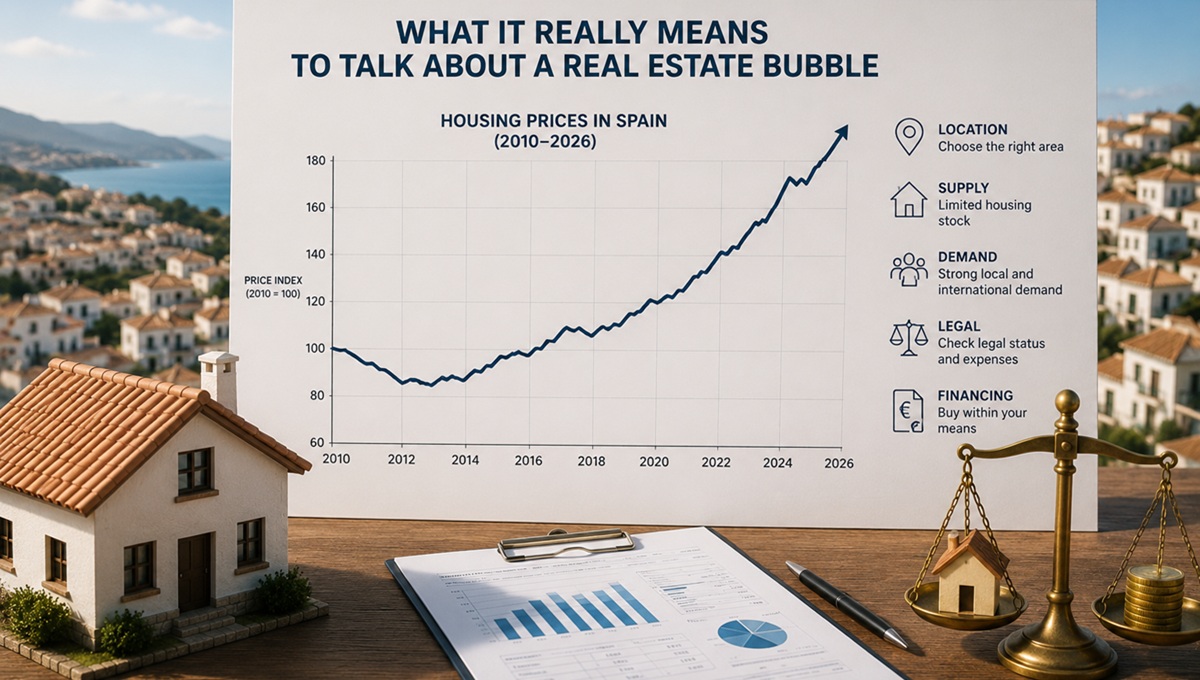
What it really means to talk about a real estate bubble
Every time house prices rise sharply, the same question comes back: are we facing another real estate bubble in Spain? It is a fair question. The memory of the last crisis is still very much alive, and as soon as the market starts to tighten, many people automatically think of a repeat of that scenario.
But it is worth turning the volume down a bit. There is a big difference between housing being expensive and the market actually being in a bubble. Not every expensive market is inflated. And not every rapid price increase means a sharp correction is about to follow.
When people talk about a bubble, what they are really describing is a market that is starting to lose touch with logic. Prices stop being supported by solid fundamentals and begin to move on exaggerated expectations, rushed decisions, and a general feeling that buying today will always be better than waiting. That is when the market becomes more fragile.
So, for a buyer in 2026, the issue should not be reduced to a simple yes or no. What is actually useful is understanding what is driving the Spanish market right now and what that means for someone who wants to buy with a reasonable degree of confidence.
What is happening in the Spanish housing market today
The overall feeling is clear: in many areas, it is harder to find property, there is less room to negotiate, and homes that are well positioned do not stay on the market for long. That makes many people feel the market is running out of control.
In many cases, though, what sits behind this is not so much a speculative spiral as a more basic problem: lack of supply. When there are more buyers than available properties, prices rise. And if that shortage is concentrated in highly sought-after locations, the effect becomes even more noticeable.
This is especially easy to see in markets where several factors come together at once:
- limited housing stock in good locations,
- active domestic demand,
- steady international interest,
- buyers looking for turnkey assets or properties with strong long-term value.
In that kind of setting, the market becomes more competitive. And a competitive market is not necessarily an inflated one. Sometimes it is simply a market with too little product and too much buying pressure.
At the heart of it, this debate matters. If the main issue is shortage, then the whole picture changes. It is not just a question of saying “everything is too expensive,” but of understanding why that is happening and where it is happening most intensely. In fact, this fits closely with the broader question of why house prices in Spain keep rising.
Does this look like what happened in 2008?
The comparison is inevitable, but it should not be made automatically. Yes, there are elements that feel familiar: high prices, a sense of urgency, reduced affordability, and a lot of conversation around the property sector.
Still, looking only at the surface can lead to quick conclusions. The current context has important differences. The average buyer tends to arrive better informed, financing is examined more carefully, and the market is driven less by excessive housing production than by insufficient supply in certain segments.
Put another way: from the outside, two markets may look similar because prices are rising; internally, they may be functioning in very different ways.
That distinction matters because it directly affects how someone should buy. It is not the same thing to enter a market driven by easy credit as it is to enter one where well-located, fairly valued and legally clean properties are hard to find. The visible outcome may look similar, but the underlying risk is not built in the same way.
What a buyer should look at before moving forward
This is the part that really matters. Beyond the headline question of whether there is a real estate bubble in Spain, what a buyer really needs to know is whether the specific deal in front of them is sound or not.
The first thing is price, but price with context. It is not enough to think a property looks expensive or cheap. The real question is whether it fits the area, the condition of the asset, comparable supply, and the actual market environment.
The second point is financing. Stretching too far has never been a good idea, and even less so in a market where any shift in costs can have a bigger impact than expected.
The third point, which is often left until the end when it should really come much earlier, is the legal side. Before signing, there is a basic checklist worth being clear about:
- who the actual owner of the property is,
- whether there are any charges or legal issues attached to it,
- what its registry and planning status looks like,
- and what tax or recurring costs the purchase may involve.
It may not seem like the most exciting part of buying a property, but it is often the part that makes the difference between a solid decision and one that becomes far more complicated later on.
For certain buyer profiles, there are also issues that are worth getting right from the start. For example, when property taxation comes into play or the purchase is being made from outside Spain.
So, is there a bubble or not?
The most sensible answer is that talking about one large, uniform bubble across all of Spain oversimplifies things. There are highly pressured areas, there are segments where prices are genuinely tight, and there are transactions that require more analysis than ever. But that does not necessarily mean the whole market is being sustained by irrational logic.
In many cases, what we are really seeing is something else: a mismatch between the supply that exists and the demand that keeps coming in. And when that imbalance persists, prices tend to rise, room for negotiation narrows, and the sense of urgency increases.
That is why, rather than sticking to one broad label, it makes more sense to look at each transaction carefully. Buying a replacement home is not the same as buying for investment or buying a second residence. Nor is a property with flawless paperwork the same as one with planning, tax or usage concerns.
And if the purchase is also intended as an investment, that review needs to go one step further. At that point, it is no longer enough for the property to look attractive or profitable on paper. What also matters is the intended use and whether that use fits the rules that apply. This is becoming increasingly relevant in purchases linked to holiday rentals or certain investment models, and it is something we also explore when discussing what should be checked before investing in tourist rentals in Andalusia.
The phrase real estate bubble in Spain continues to attract attention because it taps into a real concern: buying in a market where prices are high and where, in some areas, moving quickly can feel almost unavoidable. But recognising that tension is one thing; reducing everything to a single label is another.
In 2026, the most useful thing for a buyer is not to get carried away by alarmism or by hype. It is to understand what is pushing prices up, where there is a genuine shortage of supply, and what kind of review should be done before making a commitment.
Because in the end, buying well does not depend only on the market moment. It depends on choosing the right asset, keeping a sensible margin, and reviewing the transaction properly. That is where the difference shows between buying on impulse and buying with clear judgment.